English
 日本語
 中文


Industry News
Home / News / Industry News / Stainless Steel BSP Fittings: Thread Forms, Sealing, and Galling Prevention
News
 Home / News / Industry News / Stainless Steel BSP Fittings: Thread Forms, Sealing, and Galling Prevention
Stainless Steel BSP Fittings: Thread Forms, Sealing, and Galling Prevention
 2026.11.25
 Industry News
Content
- 1 What Makes a Stainless Steel BSP Fitting: Two Thread Forms Under One Name
- 2 BSPP versus BSPT: Sealing Logic Decides Compatibility
- 3 Stainless Grades and Galling: What 304, 316, and 316L Change
- 4 Verify a Stainless Steel BSP Fitting Thread Size and Pitch in the Field
- 5 Three Field Mistakes That Ruin Stainless BSP Joints
- 6 Frequently Asked Questions on Stainless Steel BSP Fittings
A stainless steel BSP fitting is only as dependable as the thread-form match behind it. BSPP parallel threads seal at a face; BSPT tapered threads seal at the flank; and treating the two as interchangeable produces leaks that no amount of torque can stop. Installers, maintenance crews, and purchasing engineers need the same operating facts before a line goes into service: the 55-degree Whitworth profile, the 1:16 taper rule, and the galling behavior of austenitic stainless grades.
55 degWhitworth flank angle of every BSP thread form
1:16Taper ratio that defines a BSPT tapered thread
2ISO standards: 228-1 for parallel G threads, 7-1 for tapered R threads
28-11Threads per inch across sizes from G1/8 to G2
What Makes a Stainless Steel BSP Fitting: Two Thread Forms Under One Name
BSP is not a single thread; it is a two-member family, and the distinction changes how a joint seals. The British Standard Pipe (BSP) family covers a parallel form, BSPP, marked G and governed by ISO 228-1, and a tapered form, BSPT, marked R for external threads, Rc for internal tapered threads, and Rp for internal parallel threads in a mixed joint under ISO 7-1. Both forms use the Whitworth 55-degree flank angle with rounded crests and roots, which separates them at a glance from NPT's 60-degree V profile.
The family appears across pneumatic skids, water treatment stations, hydraulic reservoirs, steam tracing, and food-contact piping. That breadth is exactly why a procurement spec for stainless steel BSP fittings should name the variant, not just the size. A G1/2 parallel adapter and an R1/2 tapered nipple are both "half-inch BSP" on paper, yet they seal on different planes and need different mating hardware. Ordering the wrong one means either a leaking joint or a re-machined port.
Where each BSP form shows up in practice
- BSPP G-series: valve ports, instrument manifolds, pump connections, and hydraulic adapters that seal with a bonded washer, an O-ring boss, or a 30-degree cone seat.
- BSPT R-series: steam, compressed air, and general industrial pipework where taper-interference sealing with sealant is accepted practice.
- Rp parallel female with R tapered male: a permitted mixed pair under ISO 7-1, common in valve bodies and filter bowls that machine an Rp port.
BSPP versus BSPT: Sealing Logic Decides Compatibility
Never bridge BSPP and BSPT without identifying which element creates the seal, because BSPP seals at a face or a separate soft component while BSPT seals at the thread flank. The two approaches share no sealing plane, which is why a BSPT male threaded into a BSPP female port with tape alone leaks under moderate service pressure in almost every installation.
| Attribute | BSPP (G) | BSPT (R/Rc/Rp) |
| Thread geometry | Parallel, 55 degrees | Tapered 1:16, 55 degrees |
| Seal location | Face, washer, O-ring, or cone seat | Thread flank interference |
| Sealant needed | None when soft seal is fitted | PTFE tape, paste, or anaerobic sealant |
| ISO standard | ISO 228-1 | ISO 7-1 |
| Common failure | Weeping at the face from a missing washer | Galling or cracking from over-torque |
Choose BSPP when
Your port is a machined face, you want repeatable break-out, and a captive O-ring or cone seat is part of the design. BSPP dominates hydraulic adapter lines and instrument connections because it does not deform the stainless thread during assembly.
Choose BSPT when
Your line is standard industrial pipework, the specification already calls for taper-interference sealing, and installers can hold torque within a tight range. BSPT is the traditional choice on steam, air, and water services.
When a parallel male termination is required on both ends of a manifold layout, a hexagonal equal-diameter adapter machines a direct connection between two BSPP ports without introducing a change of size.
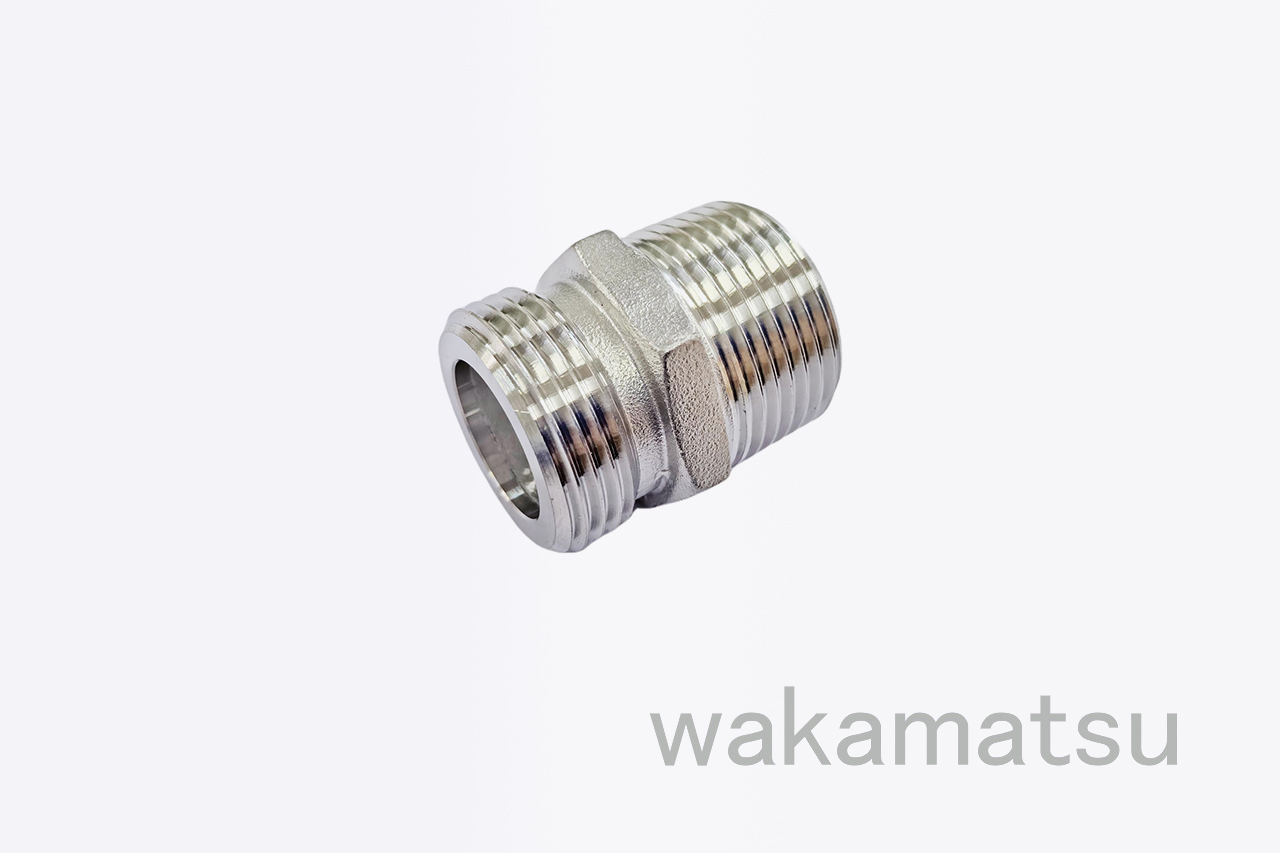 Stainless Steel Hexagonal Equal-Diameter Adapter for BSPP ConnectionsThis adapter joins two parallel male BSPP ports without changing size. The surrounding text explains how grade selection—304 versus 316/316L—affects corrosion resistance and galling, making this fitting relevant for chloride-exposed systems.View Product →
Stainless Grades and Galling: What 304, 316, and 316L Change
The grade of stainless steel BSP fittings does not alter thread geometry, but it changes corrosion resistance, surface passivation, and galling tendency under assembly torque. For dry indoor service, 304 (1.4301) keeps cost low. For chloride exposure, washdown zones, marine air, or process fluids, 316 (1.4401) adds molybdenum and lifts pitting resistance; 316L (1.4404) lowers carbon content for welded systems that must resist sensitization.
Galling is the stainless-specific failure on BSPT joints. Austenitic grades pick up and cold-weld when sliding under pressure, so a dry 316 tapered nipple can seize in its socket before reaching half the rated tightening torque. The industrial fix is controlled lubrication plus a torque ceiling, because the galling threshold sits below the yield limit of the thread form.
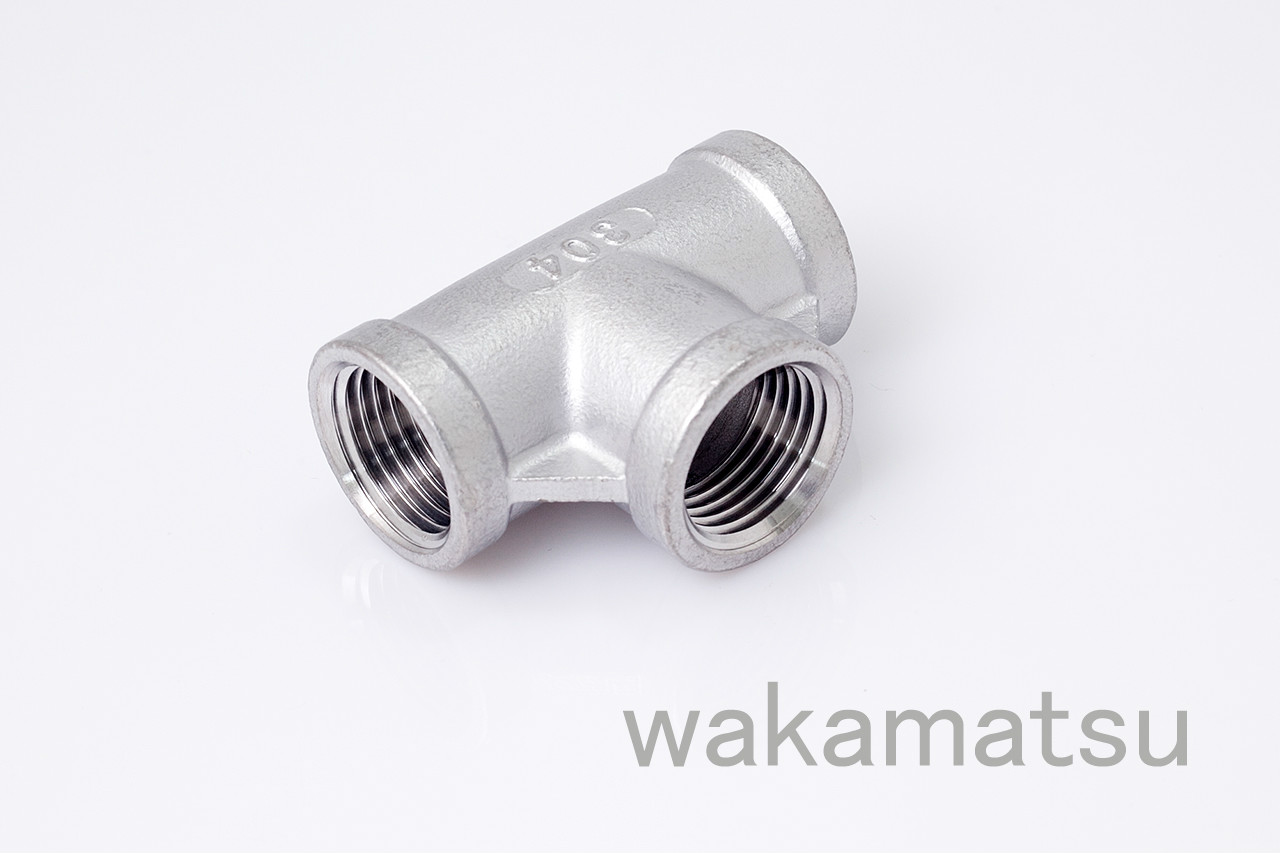 Stainless Steel Tee Fitting with BSPT ThreadsThe preceding passage discusses galling in BSPT joints and the need for lubrication and torque control. This tee fitting is positioned as a component where thread galling risks matter, so material and assembly practice are critical here.View Product →
Material and surface-finish selection for aggressive environments belongs in the same conversation as thread form. Read the corrosion-resistant stainless steel threaded connector selection guide when chloride levels, temperatures, or cleaning regimes are part of the specification.
Verify a Stainless Steel BSP Fitting Thread Size and Pitch in the Field
You identify a stainless steel BSP fitting by combining a 55-degree thread profile, measured pitch, and nominal outside diameter; no single check is enough. A caliper plus a thread-pitch gauge settles the question in five minutes, and the same method catches the two errors behind most ordering disputes: NPT parts pulled into BSP assemblies and parallel parts forced into tapered ports.
- Clean the thread with a brass brush so the profile is readable, then check the flank against a 55-degree gauge. NPT reads 60 degrees.
- Match the pitch with a thread gauge. If 19 TPI fits where you expected 14 TPI, the size, the standard, or both are wrong.
- Measure the outside diameter of the male thread with calipers and compare it with the table below. Diameter confirmation removes the guesswork between G1/2 and G3/4.
- Confirm taper by sighting along the axis; BSPT visibly slopes over its length, while BSPP remains parallel.
| Nominal size | Male thread OD (mm) | Threads per inch | Pitch (mm) |
| G1/8 | 9.728 | 28 | 0.907 |
| G1/4 | 13.157 | 19 | 1.337 |
| G3/8 | 16.662 | 19 | 1.337 |
| G1/2 | 20.955 | 14 | 1.814 |
| G3/4 | 26.441 | 14 | 1.814 |
| G1 | 33.249 | 11 | 2.309 |
| G1-1/4 | 41.910 | 11 | 2.309 |
| G1-1/2 | 47.803 | 11 | 2.309 |
| G2 | 59.614 | 11 | 2.309 |
Threads per inch from G1/8 to G2
Three Field Mistakes That Ruin Stainless BSP Joints
Three errors cause most premature leaks on stainless steel BSP fittings: mixing thread systems, over-torquing until galling, and contaminating the process with the wrong sealant. Each is preventable with a short checklist at the workbench.
- Mixing BSPP, BSPT, and NPT. A BSPP male into a BSPT port, or any BSP thread against NPT, will weep or bind because the flank angles differ by 5 degrees and the pitches rarely align. Forcing such a pair deforms the stainless thread permanently.
- Torque without lubrication. Austenitic stainless BSPT threads seize abruptly when boundary lubrication is absent. Apply anti-seize, respect the fitting maker's torque rating, and stop when the torque curve spikes rather than climbs smoothly.
- Misapplied sealant. Excess PTFE tape on BSPT fronts packs off during threading and travels downstream into instrument ports. Use a maximum of two wraps, keep tape clear of the first thread, and switch to oxygen-compatible tape in oxygen service.
Frequently Asked Questions on Stainless Steel BSP Fittings
Can a BSPP male fitting connect to a BSPT female port?
Only if the BSPP male carries a cone-seat or O-ring element that engages the port face. A plain BSPP parallel thread cannot seal against a BSPT taper because the sealing geometry used by each form is different.
How do you distinguish BSP from NPT in the field?
Check the thread angle and pitch. BSP uses a 55-degree Whitworth flank with common pitches of 28, 19, 14, and 11 TPI; NPT uses a 60-degree V thread. A BSP thread gauge will not interleave with an NPT thread profile.
Do 316L stainless steel BSP fittings eliminate galling?
No. 316L reduces sensitization in welded assemblies but does not change the galling mechanism of austenitic stainless steel. Lubrication, surface finish, and torque control remain the decisive factors on BSPT joints.
Should PTFE tape be used on stainless steel BSPT fittings?
Yes, within limits: two wraps applied in the direction of threading, with the first thread left clear. For oxygen-enriched or food processes, use the sealant grade approved for that service rather than general-purpose plumber tape.
Certificate Of Honor
If You Need More Help, Let Us Know.

ABOUT US
PRODUCTS
CAPABILITY
CONTACT US
- Phone: +86-21-59261529
- Email: sales@sh-wakamatsu.com
- Email: panhy@sh-wakamatsu.com
- Add: B3 Factory , Industrial Park, Jinze Town, Shanghai, China
Copyright © Shanghai Wakamatsu Metal Products Co., Ltd.
All Rights Reserved.Custom Stainless Steel Pipe Fitting Manufacturers, Suppliers