English
 日本語
 中文


Industry News
Home / News / Industry News / Stainless Steel BSPT Fittings: Tapered Thread Guide for Leak-Free Joints
News
 Home / News / Industry News / Stainless Steel BSPT Fittings: Tapered Thread Guide for Leak-Free Joints
Stainless Steel BSPT Fittings: Tapered Thread Guide for Leak-Free Joints
 2026.11.18
 Industry News
Content
- 1 Why the 55-Degree Taper Makes Stainless Steel BSPT Fittings a Compression Seal
- 2 BSPT vs BSPP vs NPT: Which Thread Standard Fits the Stainless Line
- 3 Stainless Steel BSPT Fittings: Sizing, Pitch, and Thread Data
- 4 304 or 316 Stainless Steel BSPT Fittings: Choosing the Grade
- 5 Installing Stainless Steel BSPT Fittings: Steps That Prevent Leaks
- 6 Why Stainless Steel BSPT Fittings Fail and How to Prevent It
- 7 Stainless Steel BSPT Fittings: Frequently Asked Questions
A 1/2-inch stainless steel BSPT fitting seals because its tapered threads deform into the mating port, not because an o-ring or gasket sits between two faces. Each turn of the 55-degree taper increases radial interference until the thread flanks lock, and that metal-to-metal lock is what carries system pressure. Get the thread form, grade, or installation torque wrong, and the joint weeps before the line is even pressurized.
BSPT stands for British Standard Pipe Taper, standardized under ISO 7-1, EN 10226, and JIS B 0203. It is the default tapered thread for stainless pipe work across Europe, Asia, and Australasia, while North American plants typically use NPT. If you specify stainless steel BSPT fittings for water, steam, compressed air, or chemical lines, the practical decisions come in a predictable order: which thread designation, which grade of stainless steel, which sealant, and how far to turn the wrench. This guide covers those decisions in the order they appear during design and assembly.
55-degree thread angle1:16 taperR and Rc designationsSealant always required
Why the 55-Degree Taper Makes Stainless Steel BSPT Fittings a Compression Seal
A stainless steel BSPT joint seals by wedge action: the male R thread and the female Rc thread are both tapered at 1:16, so every full turn increases radial interference until the flanks block the pressure path.
BSPT (British Standard Pipe Taper) is a tapered pipe thread system with a 55-degree included angle and a 1:16 taper, defined in ISO 7-1, where R designates the external tapered thread and Rc designates the internal tapered thread.
Because BSPT crests and roots are truncated, a narrow helical clearance remains even after the flanks engage. That clearance is why stainless steel BSPT fittings are always assembled with a thread sealant, PTFE tape or a pipe joint compound. The taper provides the mechanical force; the sealant fills the spiral residue. A dry BSPT joint that feels tight can still weep at working pressure.
R, Rc, and Rp: which designation goes where
ISO 7-1 defines three practical designations: R for external tapered threads, Rc for internal tapered threads, and Rp for internal parallel threads. A BSPT male R thread screws into an Rp port and jams in the first two or three threads, which is a common combination on stainless manifolds and valve bodies. Never mix BSPT with NPT in the same joint, because the thread angles do not match.
BSPT vs BSPP vs NPT: Which Thread Standard Fits the Stainless Line
Of the three pipe thread families used on stainless fittings, BSPT, BSPP, and NPT, none are fully interchangeable, and the fastest way to identify one is to measure the thread angle: 55 degrees means BSP, 60 degrees means NPT.
| Thread property | BSPT (R / Rc) | BSPP (G) | NPT |
| Included angle | 55 degrees | 55 degrees | 60 degrees |
| Taper | 1:16 | None, parallel | 1:16 |
| Sealing principle | Flank interference and sealant | Metal-to-metal face or soft washer | Flank interference and sealant |
| Dominant regions | Europe, Asia, Australasia | Europe, Asia | North America |
| Fit with a BSPT male | Intended match | Works with sealant (R into G) | Never |
Works in practiceR male into a G or Rp parallel female port, assembled with sealant, is a standard hybrid joint on instrument and manifold lines.
Fails in practiceNPT male into a BSPT female port: the 55-degree and 60-degree flanks cross-thread, cut chips, and leak under pressure.
Stainless Steel BSPT Fittings: Sizing, Pitch, and Thread Data
Nominal BSPT sizes from 1/8 to 2 inch follow a fixed pitch schedule: a 1/2-inch stainless steel BSPT fitting has 14 threads per inch and a male thread outside diameter of 20.955 mm, regardless of manufacturer.
| Nominal size | Threads per inch | Pitch (mm) | Male thread OD (mm) |
| 1/8 | 28 | 0.907 | 9.728 |
| 1/4 | 19 | 1.337 | 13.157 |
| 3/8 | 19 | 1.337 | 16.662 |
| 1/2 | 14 | 1.814 | 20.955 |
| 3/4 | 14 | 1.814 | 26.441 |
| 1 | 11 | 2.309 | 33.249 |
| 1-1/4 | 11 | 2.309 | 41.910 |
| 1-1/2 | 11 | 2.309 | 47.803 |
| 2 | 11 | 2.309 | 59.614 |
Nominal size refers to the bore of the pipe the thread is intended for, not the outside diameter of the thread. A 1/2-inch stainless steel BSPT fitting measures 20.96 mm across the male crests, not 12.7 mm. Ordering by visual comparison alone is how mismatched threads end up on site.
Thread pitch grows as nominal size increases
ISO 7-1 BSPT pitch values: fine threads on small bores, coarse 11-TPI threads from 1 inch upward.
Rule of thumb: a 1/2-inch BSPT port accepts a male thread of 20.955 mm OD with 14 TPI. If the thread count or the OD differs, stop and verify the standard before forcing the fit.
Male-to-male BSPT adapters, typically hexagonal bars threaded on both ends, are specified by the nominal size and the hex flat dimension, which controls the wrench size on stainless steel.
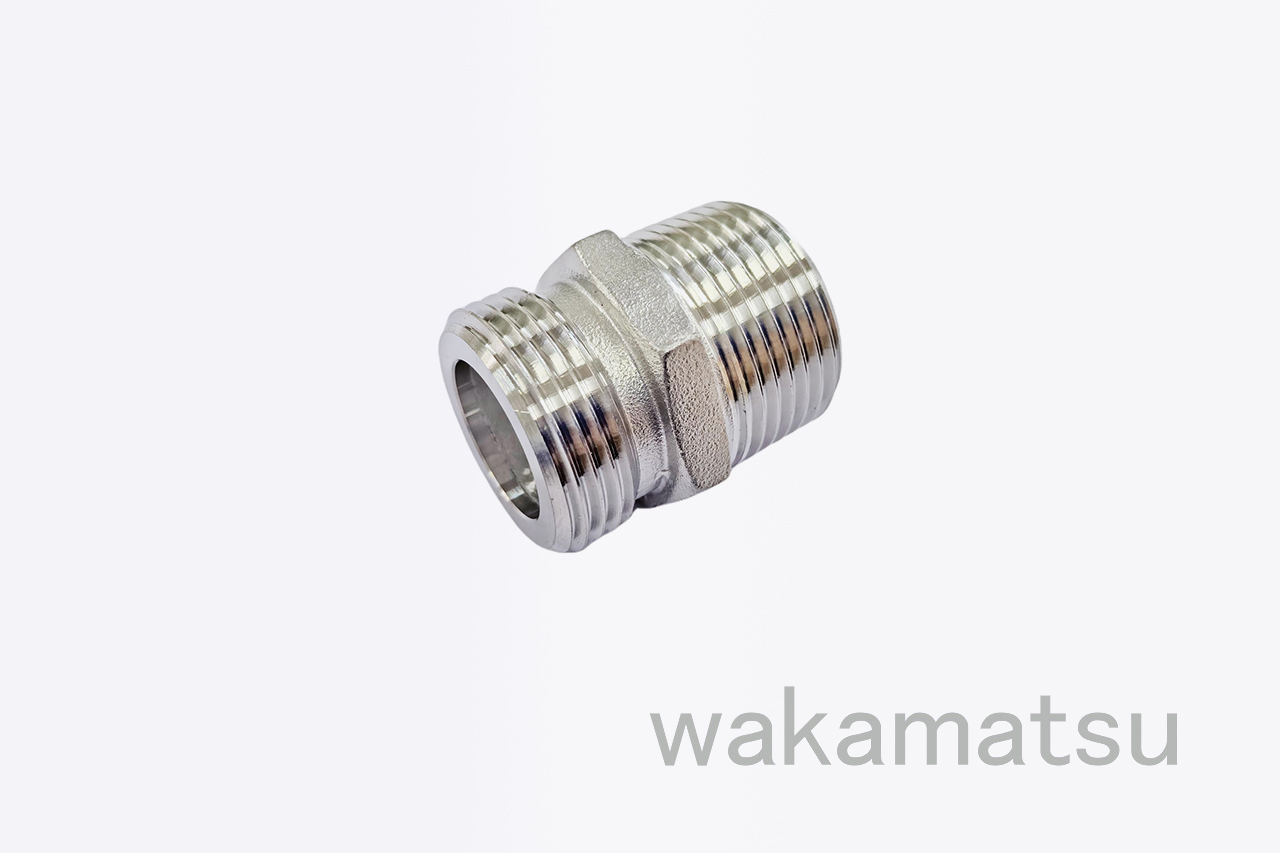 WSFG Stainless Steel Hexagonal Equal-Diameter BSPT AdapterThis hexagonal adapter connects male BSPT threads on both ends, with options in 304 or 316 grades to match your service conditions. Its smooth G thread port helps avoid leaks in stainless steel piping.View Product →
304 or 316 Stainless Steel BSPT Fittings: Choosing the Grade
Choose 304 (1.4301) for dry gases, clean water, and non-chloride service; choose 316 or 316L (1.4401 or 1.4404) for chlorides, coastal moisture, chemical media, and food-contact surfaces.
The difference is molybdenum. Roughly 2 to 3 percent molybdenum in 316 raises the pitting resistance equivalent number (PREN) from about 19 in 304 to between 24 and 26. That matters directly on threads, because pitting at the root of a tapered thread is where crevice corrosion starts.
PREN comparison: 304 sits near 19, 316 and 316L sit in the 24 to 26 range. For any line exposed to salt air or process chlorides, 316L is the defensible specification for stainless steel BSPT fittings.
Galling is the second material consideration. Austenitic stainless steel work-hardens, and a dry 316 male run into a dry 316 port can weld and tear at the flanks. Assemble stainless steel BSPT fittings with an anti-seize paste rated for stainless steel, tighten at moderate speed, and never polish the threads.
- Materials certificate with heat number traceability for pressure applications.
- ISO 7-1 or EN 10226 conformity statement on the thread form.
- Pressure-temperature rating for the fitting body, not just the thread.
For a fuller breakdown of material selection on threaded stainless connections, read the corrosion-resistant stainless steel threaded connector selection guide.
Installing Stainless Steel BSPT Fittings: Steps That Prevent Leaks
A stainless steel BSPT joint seals reliably when the threads are clean, the sealant is applied the right way, and the fitting is tightened just past the hand-tight stop, usually one to two turns, never as far as a parallel thread would go.
- Inspect the full length of the thread for chips, dents, or torn crests; a damaged flank is a ready-made leak path.
- Clean both threads with a lint-free cloth and solvent, then let them dry completely before sealant.
- Apply PTFE tape in three to four wraps pulled taut in the direction of tightening, or apply a stainless-compatible sealant paste to the male flanks.
- Screw the fitting in by hand until it stops; the taper will leave part of the thread visibly standing proud.
- Mark the hex with a reference line and tighten one to two turns with a wrench, watching the mark move past the port face.
- Pressure test the completed line before insulation, lagging, or enclosure covers the joint.
Hand-tight plus one to two turns is the entire useful travel of a stainless steel BSPT joint. If it will not seal inside that window, the thread standard, the engagement depth, or the contamination is wrong. More torque is not a fix.
For lines that see repeated assembly cycles, a bite-type compression fitting eliminates the tapered thread entirely; a hardened ring bites into the tube wall and forms the seal without galling risk on stainless steel.
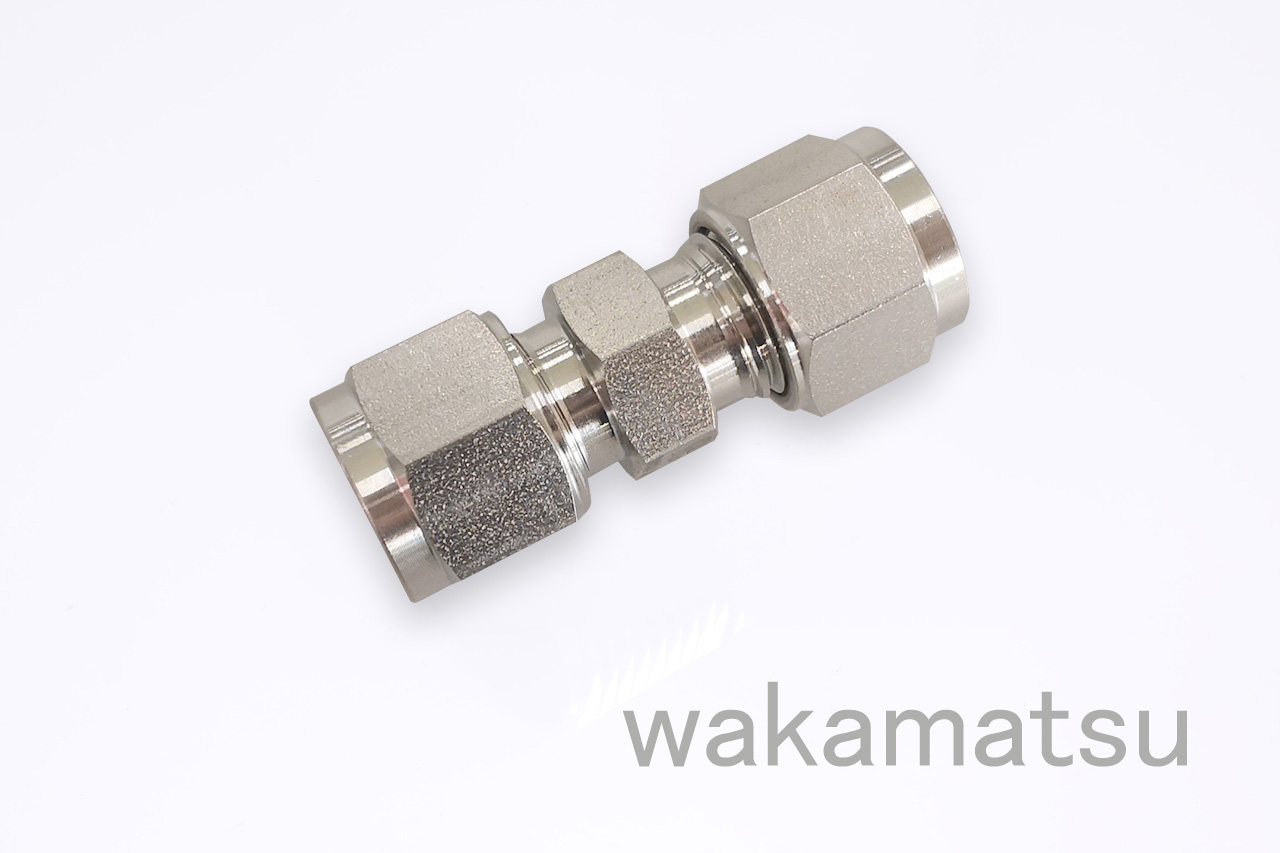 W-Ktz Stainless Steel Straight-Through Bite-Type FittingThis bite-type fitting uses a dual-ferrule design with a coated nut to prevent seizing, allowing repeated assembly and reuse without galling. It is a reliable alternative to tapered threads for stainless steel tube connections.View Product →
Why Stainless Steel BSPT Fittings Fail and How to Prevent It
Leaks and breakage in stainless steel BSPT fittings trace back to four root causes: the wrong thread standard, insufficient engagement, galling, and port deformation.
- NPT forced into a BSPT port: the angle mismatch cuts chips and the joint leaks within hours.
- Engagement too short: a counterbored port or an undersized taper leaves no interference zone for the flanks.
- Galling: dry assembly, fast tightening, or 316 against 316 without anti-seize produces torn silvery flanks.
- Port deformation: a distorted female port no longer holds any taper, and the housing has to be replaced.
| Symptom | Root cause | Correction |
| Torn, silvery thread flanks | Galling from dry assembly | Anti-seize paste and slower tightening |
| Fitting stops before one full turn | NPT or BSPP thread on a BSPT port | Verify angle with a thread gauge |
| Leak at full rated torque | Engagement depth too short | Re-tap with a correct Rc tap and check port depth |
| Cracked female port | Over-torque past the taper stop | Replace the housing; torque to the stop mark |
The strongest predictor of a leak-free stainless steel BSPT system is the thread gauge check performed before assembly, not the torque applied after it.
Stainless Steel BSPT Fittings: Frequently Asked Questions
A correctly mated R and Rc pair, in 304 or 316L, assembled with anti-seize and tightened to the taper stop, is the most durable stainless steel BSPT joint you can specify.
Can a BSPT male fitting go into a BSPP female port?
Yes, within limits. An R male thread into a G or Rp parallel female port is a common arrangement on manifolds and instruments, but the taper jams in only the first few threads. Use sealant and avoid it on high-pressure or high-vibration lines where a full Rc engagement is available.
Are BSPT and NPT threads interchangeable?
No. Both taper at 1:16, but BSPT uses a 55-degree included angle and NPT uses 60 degrees, and the thread forms differ. Forcing one into the other strips the flanks, produces metal chips, and leaks.
Why does my stainless steel BSPT fitting leak even with PTFE tape?
PTFE tape cannot compensate for a wrong taper, a damaged thread, or too-short engagement. Check the thread designation with a gauge, confirm the port depth, and use an anti-seize compound on the flanks if galling is visible.
What pressure rating applies to stainless steel BSPT fittings?
Rating is a property of the fitting body, not the thread alone. Forged stainless threaded fittings, such as those manufactured to ASME B16.11, are commonly rated at 3000 or 6000 psi cold working pressure depending on size and schedule. Always confirm against the supplier datasheet.
The seal in a stainless steel BSPT fitting is made before the wrench touches it, in the specification of the thread form, the grade, and the port geometry. Shanghai Ruosung Metal Products, a Japanese-owned manufacturer established in 2003 and ISO 9001 certified since 2008, machines threaded connectors, bite-type fittings, valves, flanges, and hose products in stainless steel for export to Japan, Europe, the Americas, and Southeast Asia. Review the threaded connector range to confirm ISO 7-1 thread forms and material certificates before you commit a line to production.
ISO 9001 since 20089,400 square meter plantExports to four regions
Related Products
Certificate Of Honor
If You Need More Help, Let Us Know.

ABOUT US
PRODUCTS
CAPABILITY
CONTACT US
- Phone: +86-21-59261529
- Email: sales@sh-wakamatsu.com
- Email: panhy@sh-wakamatsu.com
- Add: B3 Factory , Industrial Park, Jinze Town, Shanghai, China
Copyright © Shanghai Wakamatsu Metal Products Co., Ltd.
All Rights Reserved.Custom Stainless Steel Pipe Fitting Manufacturers, Suppliers