English
 日本語
 中文


Industry News
Home / News / Industry News / Stainless Steel NPT Fittings: Thread Specs, Grades and Selection Guide
News
 Home / News / Industry News / Stainless Steel NPT Fittings: Thread Specs, Grades and Selection Guide
Stainless Steel NPT Fittings: Thread Specs, Grades and Selection Guide
 2026.11.11
 Industry News
Content
- 1 How Stainless Steel NPT Fittings Actually Seal
- 2 304 or 316L: Grade Selection for NPT Fittings
- 3 Pressure Ratings: Why One NPT Fitting Has Six Numbers
- 4 Installing NPT Fittings Without Splitting a Port
- 5 NPT vs BSPT: Why the Threads Almost Fit
- 6 Stainless Steel NPT Fittings: What Belongs on the Purchase Order
- 7 FAQ
A weeping 1/2 inch NPT joint is almost never a defective fitting. It is an engagement problem. NPT threads are cut with a 1 in 16 taper, so the seal comes from metal-to-metal interference between two tapered threads, not from a gasket. Too few turns and the joint weeps under pressure, too many and the female port splits, and the wrong grade means the thread corrodes away in a single season.
That one design fact explains most of the returns we see on stainless steel NPT fittings. Buyers who order "1/2 inch, 316, NPT" and stop there leave three variables unverified: pressure class, thread gauge result, and material certificate. Each of those decides whether the shipment passes a hydrostatic test on your site or comes back on a pallet.
How Stainless Steel NPT Fittings Actually Seal
A stainless steel NPT fitting is a machined or forged connector whose threads are tapered at 1 in 16 (about 1.79 degrees per side) with a 60 degree included angle, produced to ASME B1.20.1 thread geometry and, when forged, to ASME B16.11 fitting dimensions.
Three consequences follow from that geometry, and all three change what you should order.
- The seal is structural, not elastomeric. There is no gasket in the joint. Pressure tightness comes from interference between the crests and roots of the mating threads, which is why sealant is a required assembly step rather than an optional one.
- Thread pitch changes with size. A 1/8 in NPT carries 27 threads per inch while a 2 in NPT carries 11.5. A gauge set is therefore size-specific, and a single ring gauge cannot verify a mixed warehouse.
- Make-up is semi-permanent. Every assembly deforms the crests slightly. Two or three make-ups is the practical ceiling before the joint loses its interference and begins to weep.
| Nominal size | Threads per inch | Wrench turns past hand-tight | Field note |
| 1/8 in | 27 | 2 to 2.5 | Instrument lines, easiest size to over-tighten |
| 1/4 in | 18 | 2 to 3 | Highest-volume size in process skids |
| 1/2 in | 14 | 2 to 3 | Most common line size in retrofit work |
| 1 in | 11.5 | 1.5 to 2.5 | Inspect the female port wall before make-up |
| 2 in | 11.5 | 1.5 to 2.5 | Never torque to the limit on cast bodies |
Definition
NPT stands for National Pipe Taper. It is the American tapered pipe thread standard in which pressure tightness is achieved by metal-to-metal interference between tapered threads, supplemented by sealant, rather than by a gasket or an O-ring.
For a deeper walk through thread classes, gauging practice, and grade cross-references, see the stainless steel threaded connector engineering guide published by our technical team.
304 or 316L: Grade Selection for NPT Fittings
Choose 316L for anything touching chlorides, process chemicals, steam condensate, or a cleanable medical circuit, and reserve 304 for clean water, compressed air, and dry indoor service.
The measurable difference is the pitting resistance equivalent number, calculated as chromium plus 3.3 times molybdenum plus 16 times nitrogen. Type 304 lands near 18, while 316L lands near 24 to 25. That gap appears as a chloride threshold: 304 starts to pit in stagnant water above roughly 200 ppm chloride at ambient temperature, while 316L tolerates several times that concentration before pitting begins.
| Grade | Typical composition | Best service | Failure mode to watch |
| 304 (ASTM A182 F304) | 18% Cr, 8% Ni, no Mo | Potable water, HVAC, dry air, general industry | Pitting and crevice corrosion in stagnant chloride water |
| 316 (ASTM A182 F316) | 16 to 18% Cr, 10 to 14% Ni, 2 to 3% Mo | Chemical, marine, food and beverage | Crevice attack in high-chloride, low-flow lines |
| 316L (ASTM A182 F316L) | As 316 with 0.03% maximum carbon | Medical, sterile, welded assemblies, high purity | Lower strength than 316 above 400 F |
Field note
Chloride-bearing thread compounds are a stress corrosion cracking trigger on austenitic stainless at elevated temperature. On 304 lines running above roughly 140 F, use a PTFE-based or nickel-based sealant and confirm the chloride content before it touches the thread.
Pressure Ratings: Why One NPT Fitting Has Six Numbers
Working pressure on a threaded stainless fitting is set by nominal size and wall thickness first, and by grade second. A 1/8 in forged 316 fitting carries roughly 7,900 psi, while the same design in 1 in carries about 3,400 psi.
The reason is geometric. Wall thickness grows more slowly than bore diameter, so the pressure-containing wall thins relative to the opening as size increases. Two practical rules follow. First, never quote one pressure number for a whole product family, quote it per size. Second, the weak point in a threaded joint is usually the female port rather than the fitting, because a cast CF8M valve body has far less material around the thread than a forged adapter.
Accent bar marks the 1/2 in size, the highest-volume line size in plant retrofit work.
Temperature derating sits on top of size. Austenitic stainless loses allowable stress as temperature climbs, so a joint rated 4,800 psi at ambient is typically 15 to 20 percent lower by 400 F.
Installing NPT Fittings Without Splitting a Port
A threaded joint seals between two and three wrench turns past hand-tight, in the sequence below. Deviating from that sequence is the most common cause of a leak and the most common cause of a cracked valve body.
2 to 3 wrench turns past hand-tight for sizes up to 1/2 in
1/4 turn maximum back-off when a fitting is over-rotated
2 to 3 make-ups before thread interference degrades
- Inspect and gauge before assembly. Burrs, cutting oil, and damaged crests produce false torque readings. Verify a sample of each lot with an L1 ring gauge on male threads and an L1 plug gauge on female threads.
- Apply sealant in the right direction and quantity. Wrap PTFE tape 1.5 to 2 turns following the thread helix and leave the first two threads bare so tape cannot enter the flow path.
- Make up by hand, then wrench. Hand-tight first, then two to three turns for sizes up to 1/2 in and about one and a half to two and a half turns on larger sizes. Stop when the joint is tight, not when it matches the last one.
- Protect the female side. A 1 in port in a cast body has much less wall than a forged adapter. Torquing a large fitting into a small casting is the fastest way to scrap the component.
- Recover correctly from over-rotation. Back off a quarter turn at most. Never unscrew completely and restart, because the crests have already deformed and the second make-up will be looser than the first.
- Test and record. Hydrostatic or air test at 1.5 times the design pressure, then log gauge results and make-up turns by batch so any failure can be traced to a heat number.
NPT vs BSPT: Why the Threads Almost Fit
NPT and BSPT both taper at 1 in 16, but they are not interchangeable, and a male NPT will thread into a female BSPT roughly one turn before binding.
The mismatch is in the flank angle and the pitch. NPT uses a 60 degree included angle while BSPT uses 55 degrees. Pitch differs on most small sizes as well: a 1/4 in NPT has 18 threads per inch against 19 for a 1/4 in BSPT, and a 1/8 in pair runs 27 against 28. Even where pitch happens to match, the flank angle does not, so the threads contact on a narrow band and deform instead of sealing. BSPP is different again: it is parallel rather than tapered and seals on a bonded washer or an O-ring face.
NPT (ASME B1.20.1)
- 60 degree thread angle
- 1 in 16 taper
- 1/4 in equals 18 threads per inch
- Dominant in North America and in equipment built to US standards
BSPT (ISO 7-1 / EN 10226)
- 55 degree thread angle
- 1 in 16 taper
- 1/4 in equals 19 threads per inch
- Dominant in the UK, Europe, and much of Asia-Pacific
Risk
Force-fitting a mixed pair generates galling on stainless and hoop stress on the female port. A mixed joint that passes a 150 psi air test will often weep at 900 psi, and on a cast body it may crack before it ever weeps.
If you are unsure which standard is on the equipment, the NPT versus BSPT thread comparison from our engineering desk walks through identification with a caliper and a pitch gauge.
Stainless Steel NPT Fittings: What Belongs on the Purchase Order
Specify five items in writing, because anything not written on the purchase order will not be verified at incoming inspection: grade and standard, pressure class, gauge acceptance, certification, and thread protection in packaging.
- Grade and standard. Write "ASTM A182 F316L" or "ASTM A182 F304", never just "316 stainless".
- Pressure class. Forged threaded fittings are supplied in 3000 lb and 6000 lb classes under ASME B16.11, and the class sets wall thickness rather than thread form.
- Gauge acceptance. Require L1 ring and plug gauge verification with a stated sampling plan for each lot.
- Certification. An EN 10204 3.1 mill certificate traceable to the heat number is standard for export orders into Europe and Japan.
- Surface and packaging. Pickled and passivated, free of embedded iron, with thread caps fitted and sizes bagged separately.
Shanghai Ruosung Metal Products Co., Ltd. has machined stainless steel threaded connectors, valves, butt-weld fittings, and flanges at its Jinze, Shanghai plant since 2003, and has held ISO 9001 certification since 2008. Three families cover most NPT piping work.
Male hex nipples carry a taper on both ends and are the standard connector between a valve outlet and a line run.
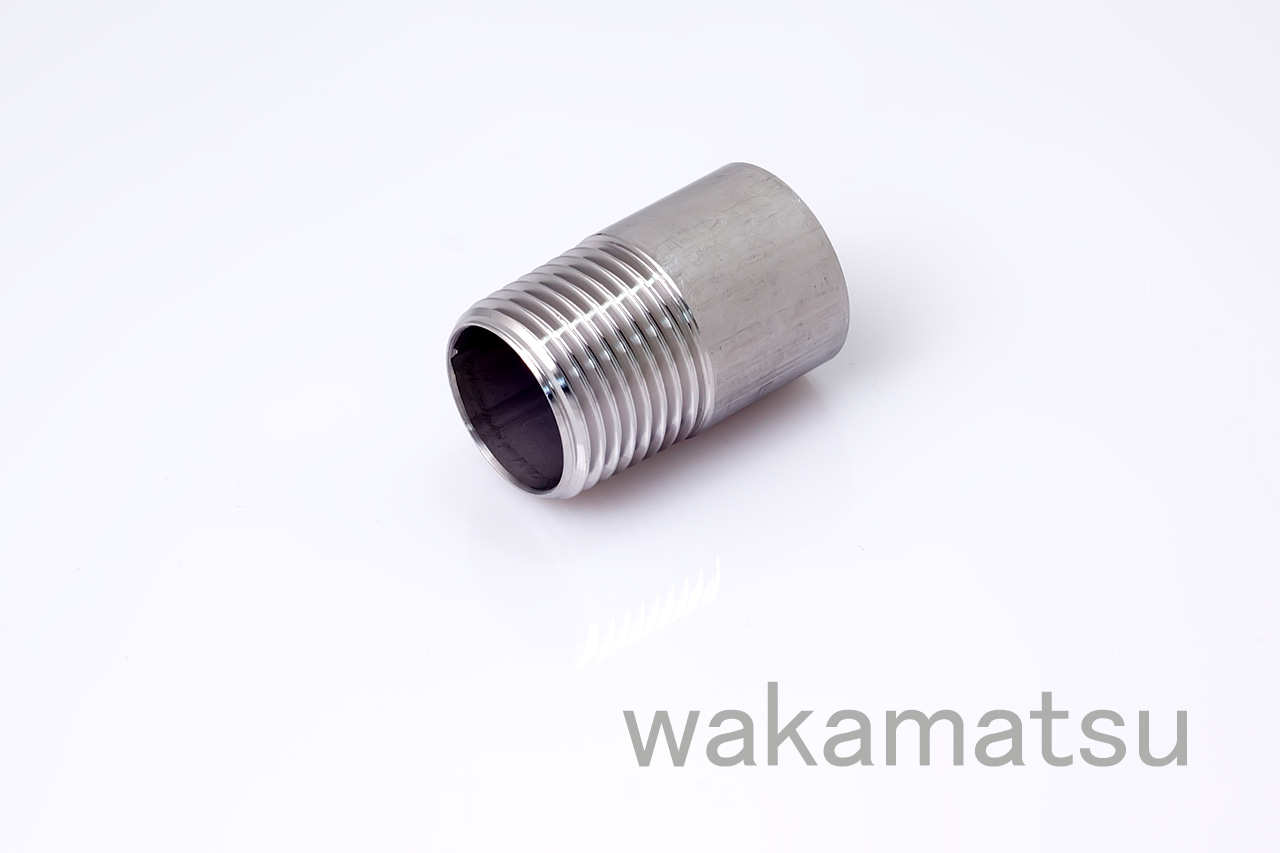 VWN/VWLN Stainless Steel Single-Ended Male Nipple ConnectorStainless steel single-ended male connector available in VWN short or VWLN long types, with R threads from 1/8 to 4 for threaded piping.View Product →
Female couplings and sockets join two male threads, which is how most instrument lines are extended and how a run is broken for maintenance.
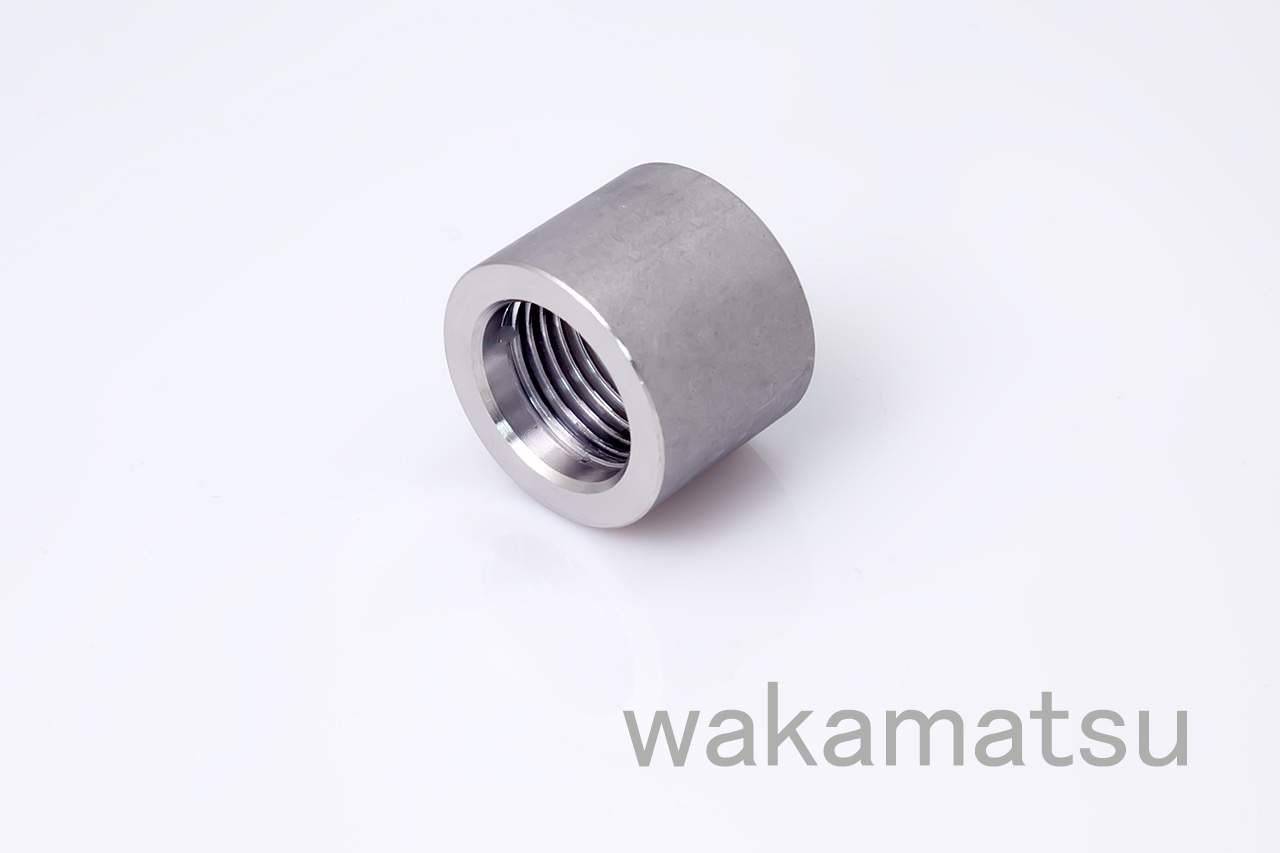 WHPTS/WHPTSB Stainless Steel Single-Ended Female Socket ConnectorStainless steel single-ended female socket offered as standard WHPTS or thin WHPTSB, with Rc threads from 1/8 to 2 for joining male threads.View Product →
Hexagonal equal-diameter adapters work as close nipples and size transitions where there is no room for a valve or a union.
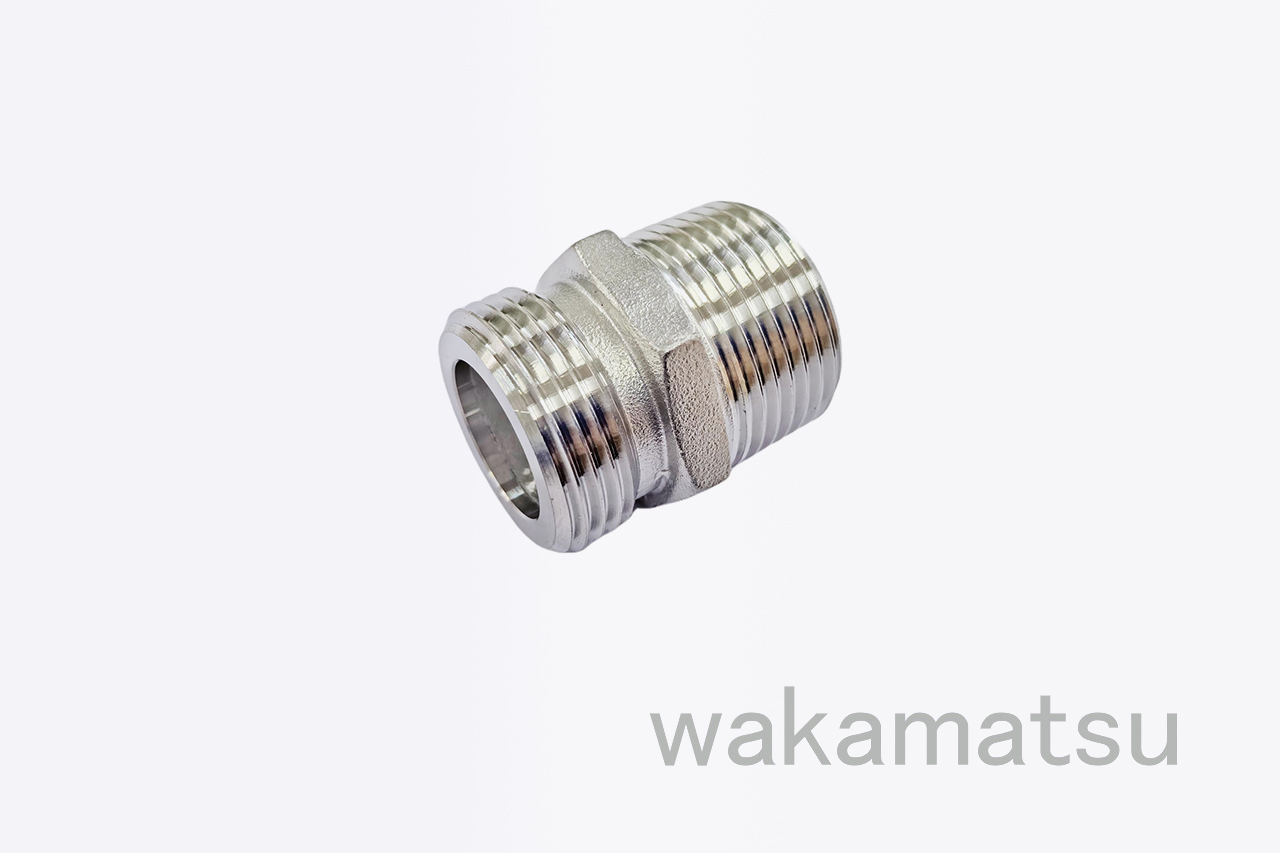 WSFG Stainless Steel Hexagonal Equal-Diameter Threaded AdapterHexagonal equal-diameter adapter for close nipple and size-transition applications, with G and R threads in DN 15A to DN 25A sizes.View Product →
FAQ
Are stainless steel NPT fittings reusable?
Yes, within limits. Two to three make-ups is the practical ceiling on a given pair of threads, because each assembly plastically deforms the crests a little more. After that, replace the fitting or re-cut the thread on a nipple where length allows.
What pressure can a 1/2 inch stainless steel NPT fitting hold?
Roughly 4,800 psi at ambient temperature in forged 316 or 316L, dropping with size and with heat. The female port and the mating pipe schedule usually decide the real limit, not the fitting itself.
Can I use PTFE tape on stainless steel NPT threads?
Yes. Wrap 1.5 to 2 turns in the direction of the thread helix and leave the first two threads bare so tape cannot enter the flow path. Avoid chloride-bearing pastes on 304 lines running hot.
How do I tell NPT from BSPT on an installed line?
Count threads over one inch with a pitch gauge. A 1/4 in NPT has 18 threads per inch and a 1/4 in BSPT has 19, while a 1/8 in pair runs 27 against 28. If the pitch matches but the joint still binds after one turn, the 60 degree versus 55 degree flank angle is the reason.
Related Products
Certificate Of Honor
If You Need More Help, Let Us Know.

ABOUT US
PRODUCTS
CAPABILITY
CONTACT US
- Phone: +86-21-59261529
- Email: sales@sh-wakamatsu.com
- Email: panhy@sh-wakamatsu.com
- Add: B3 Factory , Industrial Park, Jinze Town, Shanghai, China
Copyright © Shanghai Wakamatsu Metal Products Co., Ltd.
All Rights Reserved.Custom Stainless Steel Pipe Fitting Manufacturers, Suppliers