English
 日本語
 中文


Industry News
Home / News / Industry News / Stainless Steel Pipe Connectors: Thread, Grade and Pressure Selection Guide
News
 Home / News / Industry News / Stainless Steel Pipe Connectors: Thread, Grade and Pressure Selection Guide
Stainless Steel Pipe Connectors: Thread, Grade and Pressure Selection Guide
 2026.11.04
 Industry News
Content
- 1 Five Connector Families and How Each One Seals
- 2 Thread Standards: Where Most Field Leaks Begin
- 3 Material Choice: 304 or 316L for the Wetted Path
- 4 Pressure and Temperature Limits by Connector Style
- 5 A Six-Step Installation Sequence That Prevents Rework
- 6 Buying Checklist for Stainless Steel Pipe Connectors
- 7 FAQ: Stainless Steel Pipe Connectors
A half-inch 316L stainless steel pipe connector weighs about 90 grams and costs a few dollars. The same fitting, if it weeps during a hydrostatic test, can hold a finished skid at the dock for a full shift. That imbalance is why experienced buyers specify stainless steel pipe connectors on seal mechanism, thread standard, pressure class and reusability rather than on unit price alone.
Three decisions account for most field failures: the wrong thread standard, the wrong alloy for the media, and a torque value copied from a generic chart instead of the supplier rating table. Each one is cheap to correct on paper and expensive to correct on site.
Definition. A stainless steel pipe connector is a machined component that joins two pipe, tube or hose ends while maintaining the pressure boundary. The seal is formed by metal-to-metal deformation, a PTFE or elastomer gasket, a machined face with a captive seal, or a welded fusion line.
Five Connector Families and How Each One Seals
Almost every stainless steel pipe connector belongs to one of five families, and the family decides how the joint seals, not the alloy grade.
| Connector family | Seal mechanism | Typical ceiling | Re-makeable | Best fit |
| Threaded (NPT / BSPT) | Thread flank plus sealant | 200 bar | Limited | Instrument air, water, general industrial |
| Bite-type compression | Ferrule swaged onto the tube OD | 400 bar | No | Hydraulic and high-pressure tube runs |
| VCR metal gasket | Knife edge bites a metal gasket | 250 bar | Gasket only | Semiconductor and high-purity gas |
| Quick connect (cam and groove) | Cam arms compress a gasket | 17 bar | Yes | Chemical transfer, tanker unloading |
| Butt-weld | Fusion weld on the pipe wall | Pipe rating | No | Permanent process piping |
The figures above are typical published ceilings for half-inch components at ambient temperature, not guarantees. A joint is only as strong as its weakest element, so a 400 bar bite-type fitting threaded onto a 20 bar hose assembly is a 20 bar joint.
Choose the connector family first, then the grade. Reversing that order is how a plant ends up with VCR glands on a drainage line that only ever needed a threaded nipple.
Thread Standards: Where Most Field Leaks Begin
NPT and BSPT threads are not interchangeable, and forcing one into the other is the most common cause of leaking stainless steel pipe connectors in plants that mix Japanese, European and American equipment.
- NPT follows ASME B1.20.1 with a 60 degree thread angle on a 1:16 taper.
- BSPT follows ISO 7/1 with a 55 degree thread angle on the same 1:16 taper.
- G (BSPP, ISO 228) is parallel, so it seals on a bonded washer, never on the thread flank.
- At quarter-inch size the pitch differs as well: 18 threads per inch for NPT against 19 for BSPT.
A cross-mated pair engages one or two turns and then binds. The crests deform, the flanks never seat, and the joint keeps a spiral leak path even after it is re-tightened with more sealant. The fix is a thread gauge, not more tape.
A cross-threaded NPT to BSPT joint can pass a five-minute air test at 6 bar and still fail a helium leak check at a 1 x 10⁻⁹ mbar L/s rejection threshold. Thread interference is not a seal.
Gauge both sides before assembly: a GO ring gauge should run on by hand, and a NO-GO gauge should not enter more than two turns. Our threaded connector material grades and thread standards guide explains how to read those results against supplier drawings when two vendors quote the same nominal size.
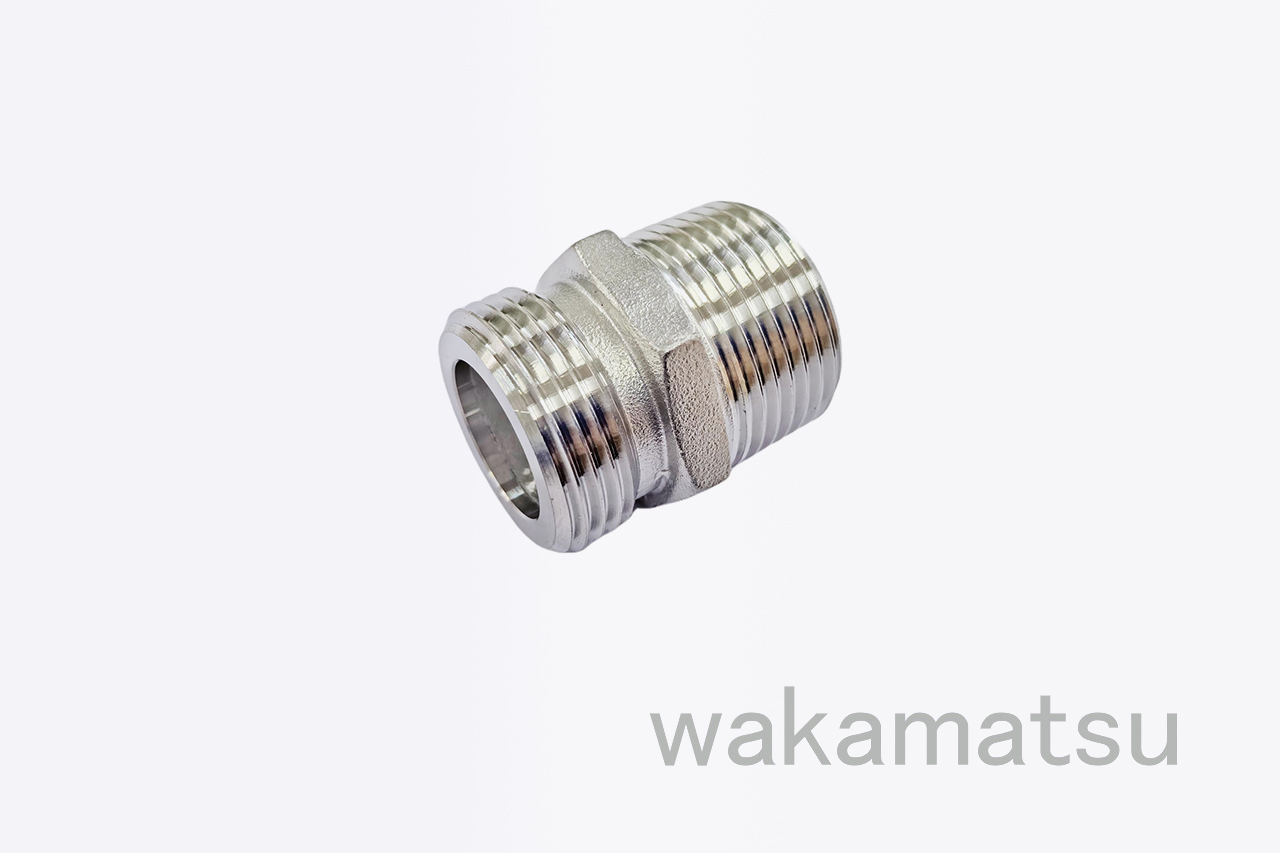 WSFG Stainless Steel Hexagonal Equal-Diameter Threaded AdapterWSFG stainless steel adapter with G- and R-thread ports in 15A–25A; check pressure/temperature ratings and thread fit before assembly.View Product →
Material Choice: 304 or 316L for the Wetted Path
Specify 316L for any wetted path exposed to chlorides, coastal air or post-weld service, and keep 304 for dry indoor duty where the cost difference matters more than pitting resistance.
2-3% Molybdenum content in 316L
0.03% Maximum carbon, which protects welds
25 Typical PREN against about 18 for 304
Molybdenum is the reason for that gap. The pitting resistance equivalent number, calculated as chromium plus 3.3 times molybdenum plus 16 times nitrogen, lands near 18 for 304 and near 25 for 316L. In practice that pushes the chloride threshold for pitting from roughly 200 ppm to about 1,000 ppm at ambient temperature, which is the difference between a two-year fitting and a fifteen-year fitting on a cooling circuit.
Purchase check. Ask for an EN 10204 3.1 mill certificate traceable to the heat number, then verify the alloy on the bench. A 316L bag containing 304 connectors looks identical until an XRF gun reads the molybdenum peak, and mismatched grades are consistently among the top causes of premature chloride pitting.
Pressure and Temperature Limits by Connector Style
Working-pressure ceilings differ by more than an order of magnitude between connector families, and temperature derating cuts them further once seals leave their design range.
Typical published ceilings for half-inch 316L components at 20 C ambient. The dark bar marks a butt-welded joint, which is limited by the pipe wall rather than by the fitting. Confirm every value against the supplier rating table and derate for temperature per ASME B31.3.
Temperature is the second limit that buyers miss. A PTFE-seated connector usually carries a continuous rating near 200 C, and above that only metal-gasket or graphite-seated designs hold their class. Ordering a PTFE-seated ball valve for a 250 C steam header is a scheduled failure, not a bargain.
Pressure ratings are only valid inside their temperature window. A 400 bar ferrule fitting derated to 60 percent at 200 C is a 240 bar fitting on paper and a leak in practice.
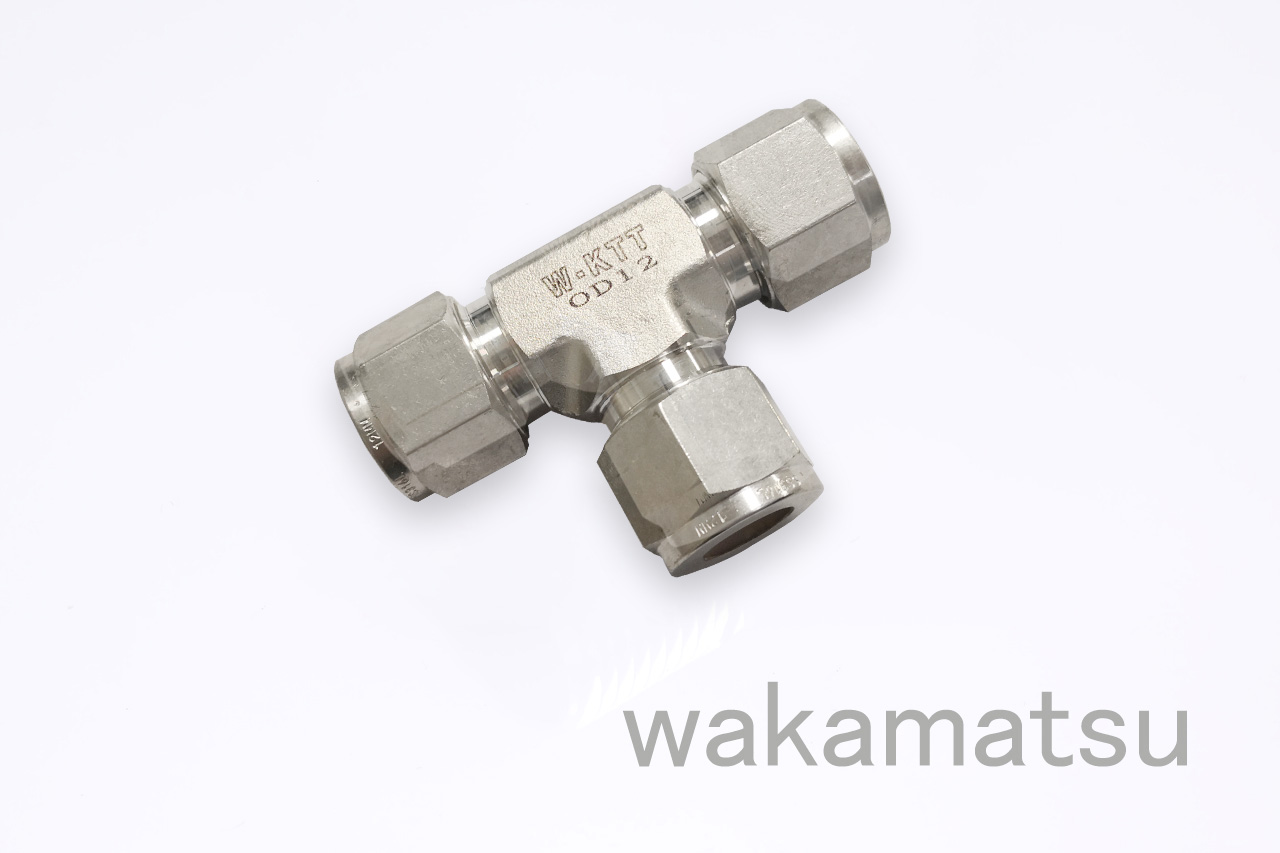 W-KTT Stainless Steel Tee Bite Type FittingStainless steel tee with live-load dual-ferrule design and anti-seize coated nut for repeated disassembly, available in DN 3.18–12.7 for bite-type tube connections.View Product →
A Six-Step Installation Sequence That Prevents Rework
Six checks separate a joint that holds helium for a decade from one that weeps on the first thermal cycle.
Verify the standard and heat number before the box is opened. A GO and NO-GO thread gauge plus one PMI reading take two minutes and catch most mixed-lot errors.
Inspect sealing surfaces under 30x magnification. A radial scratch on a VCR knife edge or a nick on a cone seat leaks regardless of how much torque is applied.
Apply sealant to threaded joints only. Two to three wraps of PTFE tape clockwise, leaving the first two crests bare, or anaerobic sealant for hydraulic duty. Never both on the same joint.
Torque to the supplier table, not to feel. A half-inch 316L NPT joint typically lands between 30 and 40 Nm, while a quarter-inch VCR gland nut usually stays between 20 and 25 Nm.
Treat ferrules and gaskets as single-use parts. A swaged ferrule cannot be re-seated, and a re-used VCR gasket is a leak with a delivery date.
Pressure test at 1.5 times design pressure, then helium leak test where specified. A soap bubble test at 6 bar will never find a 10-9 mbar L/s leak.
Flexible and quick-connect assemblies need their own sequence because the hose, not the fitting, carries the load. The flexible pipe connector installation guide covers support spacing and minimum bend radius for those runs.
Buying Checklist for Stainless Steel Pipe Connectors
Four documents and two physical checks separate a controlled manufacturing source from a trading intermediary.
- An EN 10204 3.1 mill certificate traceable to the heat number stamped on the bag or box.
- A dimensional report against ASME B1.20.1 or ISO 7/1, including thread gauge results per lot.
- A helium leak test certificate for VCR glands, quick connectors and any pre-assembled hose.
- ISO 9001 certification that names the machining site rather than a trading address. Shanghai Ruosung Metal Products has held ISO 9001 since 2008 and machines connectors in-house at its Jinze facility in Shanghai.
The two physical checks are simple: PMI three pieces per lot with an XRF gun, and run thread gauges on five pieces per shipment. Both take under twenty minutes and eliminate the majority of incoming-material disputes.
For maintenance and transfer duty, cam and groove quick connectors remove the thread question entirely, since both halves are keyed and the gasket does the sealing. They are the right answer for tanker unloading and temporary chemical lines, and the wrong answer anywhere above 17 bar.
 W-KSA Stainless Steel Quick ConnectorW-KSA stainless steel quick connector with external dimensions from 3/4 in to 4 in, suited to applications where thread-standard mismatches are a concern.View Product →
FAQ: Stainless Steel Pipe Connectors
Are NPT and BSPT stainless steel pipe connectors interchangeable?
No. NPT uses a 60 degree thread angle and BSPT uses 55 degrees, and the pitches differ at some sizes such as quarter-inch, where NPT is 18 threads per inch and BSPT is 19. A cross-mated pair binds after one or two turns and leaves a spiral leak path. Gauge every joint and keep the two standards in separate bins.
Should I specify 304 or 316L for a water line?
Potable and process water below roughly 200 ppm chloride is normally fine in 304. Above that, or anywhere the line sits wet and stagnant, specify 316L. The price difference is typically 20 to 30 percent on the fitting, which is small measured against one unplanned shutdown.
Can a bite-type connector be re-tightened if it starts to weep?
No. The ferrule is swaged into the tube on first make-up, so re-tightening deforms the tube wall further and usually worsens the leak. Cut the tube back behind the deformed section, fit a new ferrule and re-make the joint from scratch.
What test pressure should a leak check use?
Hydrostatic testing at 1.5 times design pressure is the standard starting point, followed by a helium leak check when the specification requires it. Air or nitrogen at 6 bar will not reveal a leak in the 10-9 mbar L/s range that semiconductor and medical gas systems are specified against.
The cheapest connector on a quotation is rarely the cheapest connector on a site. Specify the family, the thread standard and the alloy up front, and the joint becomes a one-time task instead of a recurring one.
Certificate Of Honor
If You Need More Help, Let Us Know.

ABOUT US
PRODUCTS
CAPABILITY
CONTACT US
- Phone: +86-21-59261529
- Email: sales@sh-wakamatsu.com
- Email: panhy@sh-wakamatsu.com
- Add: B3 Factory , Industrial Park, Jinze Town, Shanghai, China
Copyright © Shanghai Wakamatsu Metal Products Co., Ltd.
All Rights Reserved.Custom Stainless Steel Pipe Fitting Manufacturers, Suppliers