English
 日本語
日本語 中文
中文

Industry News
Home / News / Industry News / Stainless Steel Flexible Pipe Connectors: Grades, End Fittings & Installation
News
 Home / News / Industry News / Stainless Steel Flexible Pipe Connectors: Grades, End Fittings & Installation
Stainless Steel Flexible Pipe Connectors: Grades, End Fittings & Installation
 2026.09.16
 Industry News
Content
- 1 What Is a Stainless Steel Flexible Pipe Connector?
- 2 Material Grades: Match the Steel to the Service
- 3 End Connections for Stainless Steel Flexible Pipe Connectors
- 4 Application Fit: Where Stainless Steel Flexible Pipe Connectors Work
- 5 Installation Best Practices for Flexible Connectors
- 6 Common Failure Modes and How to Prevent Them
- 7 Flexible Connector FAQ
- 7.1 What is the difference between a corrugated bellows connector and a braided flexible hose?
- 7.2 Can stainless steel flexible pipe connectors be used for gas service?
- 7.3 How long do stainless steel flexible pipe connectors last?
- 7.4 Are flexible connectors allowed in fire-protection and seismic systems?
A welded stainless steel pipe run at a beverage plant cracked at the pump discharge after eighteen months: the hard piping had no way to absorb 1.2 mm of lateral pump movement and 40°C of thermal cycling. Replacing it with a stainless steel flexible pipe connector fitted with a corrugated 316L bellows and braided reinforcement stopped the cracking, because these assemblies absorb 15-25 mm of axial movement per meter of hose length and tolerate working pressures up to 2.5 MPa. That combination of movement capacity and pressure rating is why flexible connectors are standard in process, marine, and fire-protection lines.
Shanghai Ruosung Metal Products Co., Ltd., a Japanese-invested manufacturer founded in 2003 in Shanghai's Jinze Town, produces a full range of stainless steel connection components, including hose connectors, flexible pipe joints, and threaded fittings. The company operates a 9,400-square-meter facility under ISO 9001 procedures certified since 2008, and exports to Japan, Europe, the Americas, and Southeast Asia.
What Is a Stainless Steel Flexible Pipe Connector?
A stainless steel flexible pipe connector is a non-rigid piping component that joins two fixed points while absorbing axial travel, lateral offset, or angular deflection without transferring damaging stress to pumps, valves, or flanges.
Definition: stainless steel flexible pipe connectors are pressure-bearing bellows assemblies: a corrugated metal tube, a protective braid, and end fittings, designed to contain fluid at operating pressure while allowing controlled movement of the connected pipe.
The corrugated bellows is the active element. Its convolutions open and close elastically with movement, while the stainless braid contains internal pressure and shields the bellows from abrasion. Product ranges are organized into three families.
- Unbraided corrugated connectors: low cost, used in vent and overflow lines without positive pressure.
- Single-braided flexible hoses: the default for water, gas, and steam service at pressures from 1.6 to 2.5 MPa.
- Double-braided bellows assemblies: specified for high-pressure, high-cyclic duty where a fail-safe outer layer is required.
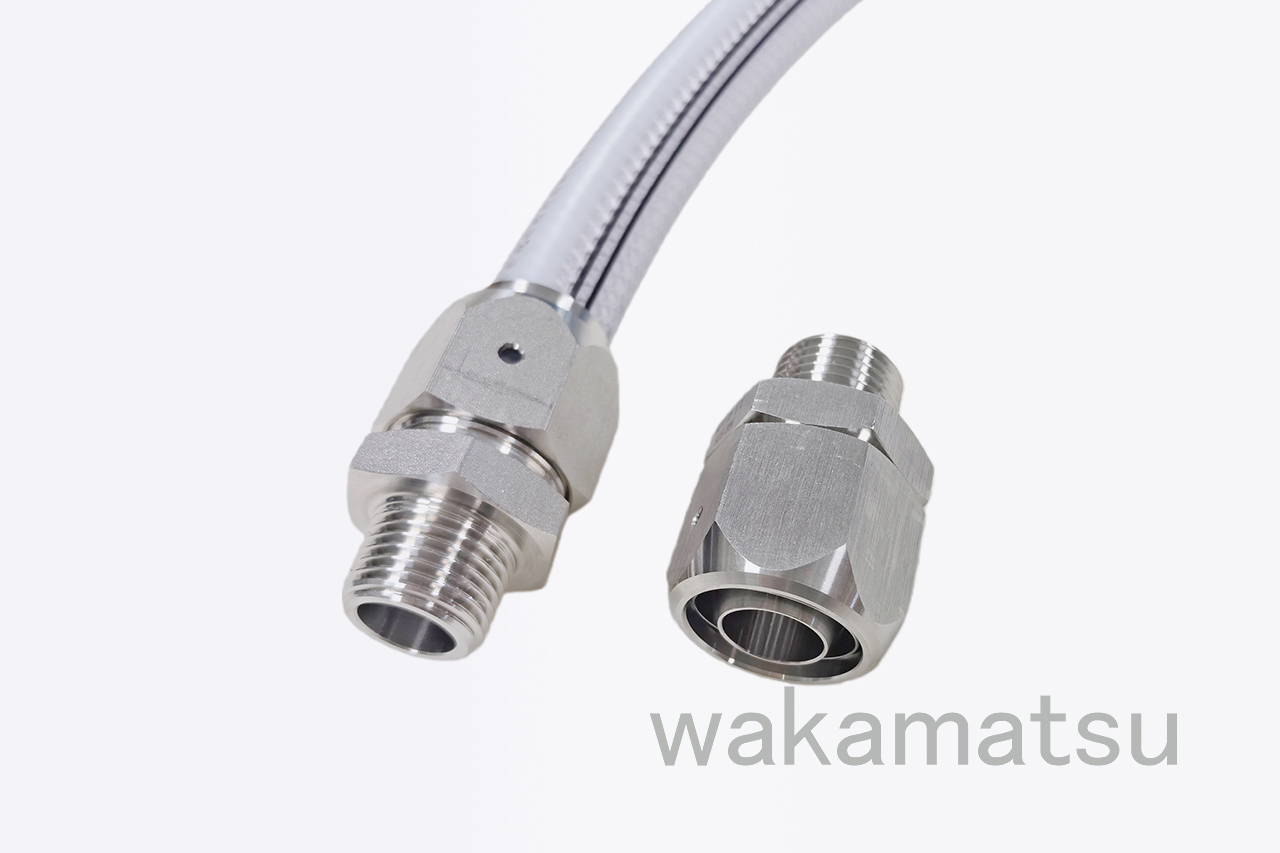 Stainless Steel Hose Connector Fittings for Leak-Proof Fluid SystemsThis connector series offers threaded, flanged, and quick-connect options in stainless or carbon steel, designed for reliable sealing and pull-out resistance in high-pressure hydraulic, pneumatic, and water hose assemblies.View Product →
These families form the stainless steel hose connector line produced by Shanghai Ruosung, with end fittings engineered to match the mating piping system.
Material Grades: Match the Steel to the Service
316L stainless steel is the default bellows material for wet or corrosive service because its higher molybdenum content resists pitting and stress-corrosion cracking; 304 is acceptable only for dry, indoor, non-chemical lines.
The comparison starts with the Pitting Resistance Equivalent Number (PREN), which ranks alloys by chloride resistance. A 316L bellows has a PREN of roughly 26, against 19 for 304; a meaningful margin when the line carries steam condensate, seawater spray, or chlorinated water.
304
19
304L
20
316
24
316L
26
904L
34
Pitting Resistance Equivalent Number (PREN) by grade: higher values mean better resistance to chloride pitting.
Cost follows corrosion resistance: a 316L bellows typically costs 40-60 percent more than the same bellows in 304, but in wet service the life gain is two to three times. For continuous seawater contact, 904L or PTFE-lined assemblies are specified, even though lead times are longer.
| Grade | PREN | Chloride resistance | Typical service | Cost index |
| 304 | 19 | Low; SCC risk above 60°C with chlorides | Dry air, inert gas, indoor plumbing | 1.0 |
| 304L | 20 | Low, less weld sensitization | Low-temperature welded assemblies | 1.05 |
| 316 | 24 | Moderate | General process, food, pharma water | 1.4 |
| 316L | 26 | High; recommended for wet lines | Steam, seawater spray, chemical dosing | 1.5 |
In coastal plants, 316L bellows regularly outlast 304 bellows by two to three times in brackish cooling-water service.
End Connections for Stainless Steel Flexible Pipe Connectors
End connection compatibility is the first specification gate: a 1-inch NPT male thread will not seal against a BSPT socket, and a butt-weld end must match the schedule of the mating line.
Industrial stainless steel flexible pipe connectors are ordered with one of five termination styles, and each has a different pressure reference relative to the bellows rating.
| End style | Standard | Typical size range | Pressure reference |
| NPT male thread | ASME B1.20.1 | 1/4 in to 2 in | 1.6 MPa at 20°C |
| BSPT / BSPP | ISO 7-1 / ISO 228 | 1/4 in to 2 in | 1.6 MPa at 20°C |
| Butt weld | ASME B16.25 | all sizes | Up to full pipe rating |
| Socket weld | ASME B16.11 | 1/4 in to 2 in | Up to full pipe rating |
| Flange | ANSI 150 / JIS 10K | DN15 to DN200 | 2.0 MPa at 20°C |
The weakest link is usually the threaded connection. Each thread engagement rotates the bellows slightly, and torquing the connector body instead of the fitting hex twists the bellows, creating early crack sites.
Practical rule: never torque through the bellows. Hold the fitting hex with a back-hold spanner while tightening, and inspect the bellows for visible twist before the line is pressurized.
Application Fit: Where Stainless Steel Flexible Pipe Connectors Work
Install a stainless steel flexible pipe connector wherever relative thermal movement between pipe ends exceeds about 3 mm, wherever pump or compressor vibration enters a rigid line, or wherever differential settlement can shift connected equipment.
Quantify the need before specifying: a 10-meter stainless steel line heated from 20 to 120°C grows roughly 15 mm, and pump nozzle reaction forces can move a flange laterally by more than 1 mm. Rigid fittings convert that movement into bending stress at the equipment connection; a flexible connector decouples the equipment from the pipe.
Rigid hard-piped connection
- Movement allowance: zero
- Vibration: transmitted fully
- Fatigue life: short at stress raisers
- Alignment: precision required
Stainless flexible connector
- Movement: 15-25 mm axial, +/-10 mm lateral
- Vibration: largely damped by the bellows
- Fatigue: designed for 50,000+ cycles
- Alignment: tolerant to +/-5 mm
15.5 mmThermal growth of a 10 m line for a 100°C rise
2.5 MPaTypical rated working pressure of braided connectors
50,000Design cycles recommended for stainless bellows (EJMA)
350°CMaximum service temperature for a standard 316L bellows
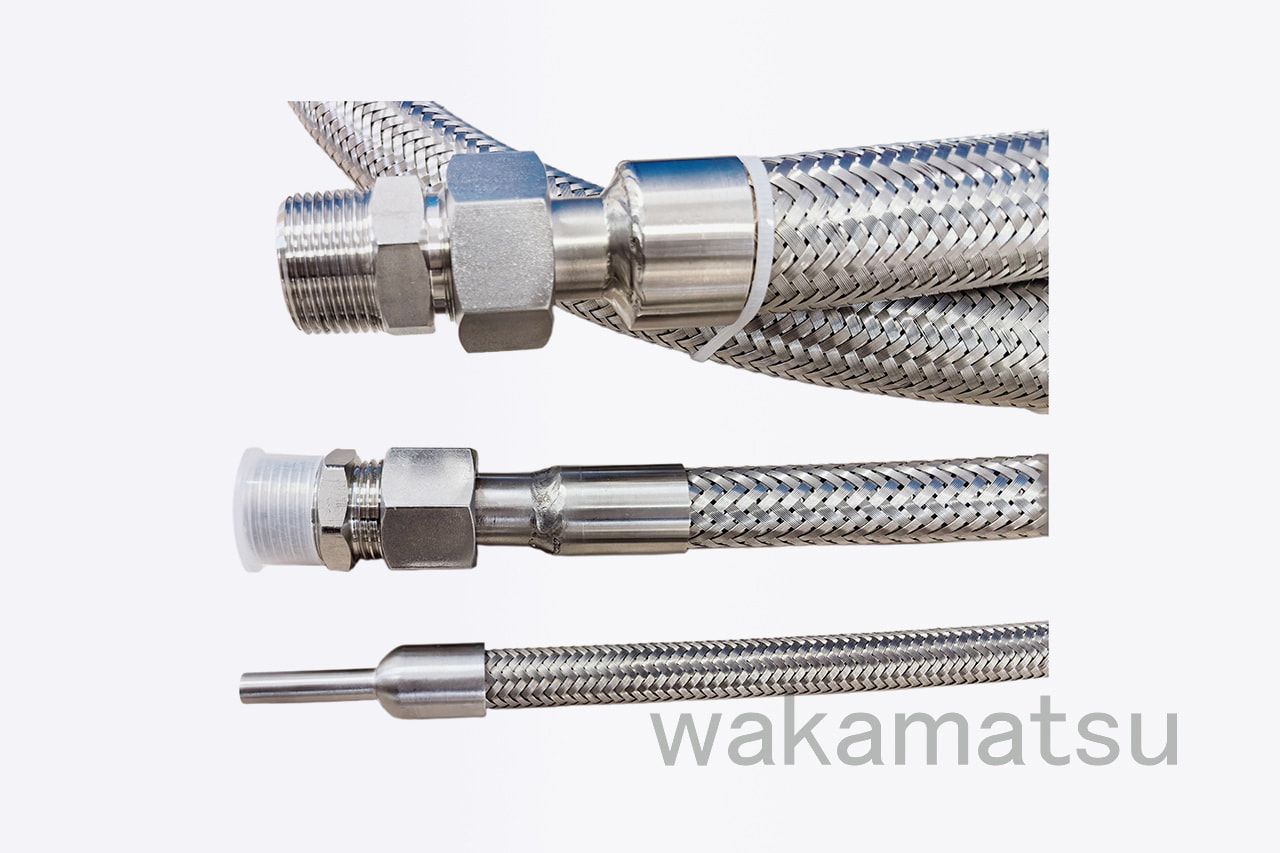 Flexible Pipe Joints with 316L Bellows for Thermal MovementThese joints absorb vibration, compensate for displacement from thermal expansion or settlement, and reduce nozzle reaction forces. With 316L bellows and weld or flange ends, they suit pump and compressor discharge lines.View Product →
For pump and compressor discharge lines that need axial and lateral movement together, the Shanghai Ruosung range includes flexible pipe joints with 316L bellows and weld or flange ends.
If the calculated thermal movement exceeds 3 mm, or vibration at the pump discharge exceeds 0.5 mm/s RMS, specify a flexible connector as a required component, not an accessory.
Installation Best Practices for Flexible Connectors
Correct installation keeps the connector relaxed, aligned, and free of torsion; a connector twisted or stretched during fitting will fail in months instead of reaching its rated service life.
- Calculate the required movement from pipe expansion tables and pump nozzle loads, then select a connector whose rated movement exceeds the calculated value by at least 30 percent.
- Position the connector between the end fittings while it is still restrained, and remove shipping supports only after the assembly is in place.
- Align both end fittings so the bellows remain straight and centered along the pipe axis before tightening.
- Torque threaded or flanged connections while holding the fitting hex with a back-hold spanner; never grip or rotate the bellows.
- Pressurize and inspect for twist, braid fraying, or contact with adjacent equipment; all three indicators should be absent.
For traced or insulated lines, leave the bellows exposed for visual inspection and confirm that insulation does not fill the convolution gaps.
Common Failure Modes and How to Prevent Them
Most field failures of stainless steel flexible pipe connectors come from torsion during installation, over-extension beyond rated movement, or chloride stress-corrosion cracking at the bellows convolutions.
- Twisted bellows: caused by torquing through the body; reduces service life from years to months.
- Over-extension: installing the connector longer than its free length to bridge a gap pulls the convolutions open and creates crack sites.
- Chloride stress-corrosion cracking: in coastal atmospheres, 304 bellows can crack within weeks; 316L resists but is not immune above 60°C with wet chlorides.
- Braid chafing: external abrasion from adjacent piping wears the braid wires and leads to localized failure.
- Gasket blowout: mismatched flange gaskets or uneven bolt torque defeats the seal at the end fitting.
Leaks in flexible connector systems are not always caused by the connector itself. Welded joints in the same line can fail independently; the analysis of leakage caused by weld defects shows pinholes concentrated at insufficiently purged root passes on stainless steel pipe.
A flexible connector performs safely only when the total displacement stays inside the rated envelope; beyond that envelope, the connector itself becomes the crack initiation site and the weakest point of the line.
Flexible Connector FAQ
What is the difference between a corrugated bellows connector and a braided flexible hose?
A corrugated bellows connector flexes through thin-walled convolutions and absorbs large movements, but its working pressure is lower. A braided flexible hose adds a woven stainless braid that contains pressure and extends fatigue life, making it the standard for pressurized process lines.
Can stainless steel flexible pipe connectors be used for gas service?
Yes, when the connector is rated for gas and the gasket is compatible. For LPG or natural gas, specify certified threaded or welded ends and verify the maximum operating pressure against the connector rating.
How long do stainless steel flexible pipe connectors last?
Under rated movement, pressure, and temperature, a 316L braided connector is typically designed for 50,000 or more cycles, which is 10 to 15 years in normal plant service. Corrosion, torsion, or exceeding the rated movement shortens that sharply.
Are flexible connectors allowed in fire-protection and seismic systems?
Yes. Flexible couplings are standard in seismic-design piping because they absorb differential building movement. For fire-protection service, select a connector with a documented fire rating and install it to the project's seismic and NFPA requirements.
Before ordering, confirm three numbers: operating temperature range, maximum working pressure, and the total axial plus lateral movement the line actually sees.
When your line shows vibration cracks, thermal-expansion leaks, or repeated gasket failures, measure the movement first, then choose the material grade and end connections. A 316L braided stainless steel flexible pipe connector with correctly matched ends generally pays back its cost in the first avoided repair.
Certificate Of Honor
If You Need More Help, Let Us Know.

ABOUT US
PRODUCTS
CAPABILITY
CONTACT US
- Phone: +86-21-59261529
- Email: sales@sh-wakamatsu.com
- Email: panhy@sh-wakamatsu.com
- Add: B3 Factory , Industrial Park, Jinze Town, Shanghai, China
Copyright © Shanghai Wakamatsu Metal Products Co., Ltd.
All Rights Reserved.Custom Stainless Steel Pipe Fitting Manufacturers, Suppliers