English
 日本語
日本語 中文
中文

Industry News
Home / News / Industry News / 304 Stainless Steel Pipe Fittings: Grades, Ratings, and Selection Tips
News
 Home / News / Industry News / 304 Stainless Steel Pipe Fittings: Grades, Ratings, and Selection Tips
304 Stainless Steel Pipe Fittings: Grades, Ratings, and Selection Tips
 2026.09.23
 Industry News
Content
- 1 What 304 Stainless Steel Pipe Fittings Actually Guarantee
- 2 Pressure and Temperature Limits for 304 Stainless Steel Pipe Fittings
- 3 Choosing 304 Stainless Steel Pipe Fittings by Connection Type
- 4 Incoming Inspection Checklist for 304 Fittings
- 5 Building a Complete 304 System: Valves, Strainers, and Flanges
- 6 Frequently Asked Questions
A water-treatment plant in Jiangsu lost six weeks of uptime when its stainless steel pipe fittings pitted at the threaded joints after exposure to 150 ppm chloride process water. The mill certificate said 304, but the fitting surfaces had been mechanically ground, which stripped the protective chromium oxide layer. That failure is a reminder that 304 stainless steel pipe fittings are not a one-line spec: grade, surface condition, and connection type must work together.
What 304 Stainless Steel Pipe Fittings Actually Guarantee
304 stainless steel pipe fittings are austenitic fittings defined by a nominal composition of 18% chromium and 8% nickel, with a maximum carbon content of 0.08%. Under ASTM A182, the forged fitting grade is UNS S30400; pipe is covered by ASTM A312 and bar by A276. The 18/8 ratio provides the work-hardening behavior, weldability, and atmospheric corrosion resistance that make 304 the default grade for food, beverage, pharmaceutical, and light industrial piping.
The grade designator alone settles nothing. It does not specify wall thickness, pressure class, thread form, or surface finish. Those come from ASME B16.11 for socket-weld and threaded fittings, from ASME B1.20.1 for NPT threads, and from the manufacturer's tolerances. A fitting stamped "304" that arrives without a certified mill test report is not traceable material, and traceability is the first thing a quality audit will request.
18.0%Min Chromium
8.0%Min Nickel
0.08%Max Carbon
515 MPaTensile Strength
Standards That Govern 304 Fittings
- ASTM A182: forged flanges, fittings, and valves
- ASTM A312: seamless and welded pipe
- ASME B16.11: dimensions and pressure ratings for socket-weld and threaded fittings
- ASME B1.20.1: NPT thread form and gauge tolerances
- JIS B2302/B2303: Japanese threaded and socket-weld fitting dimensions
A 304 stamping without a certified mill test report is not traceable material. Reject it before it reaches your stores.
Pressure and Temperature Limits for 304 Stainless Steel Pipe Fittings
The maximum continuous service temperature for 304 stainless steel pipe fittings in non-cyclic service is about 425°C, but pressure ratings derate sharply before that limit. Per ASME B31.3, the allowable stress for 304 at 20°C is roughly 138 MPa; at 400°C it falls to approximately 70 MPa. That 50% drop means a fitting selected for a cold line may be unacceptable for steam or hot-process service.
Threaded fittings made to ASME B16.11 carry Class 2000, 3000, or 6000 ratings based on cold working pressure. A Class 3000 threaded coupling is rated near 3000 psi at ambient temperature, but at 300°C the rating falls to about 1800 psi. If hot service is part of the duty, reduce the operating pressure or move to a butt-weld connection, which retains full pipe-wall strength.
When 304 Is Not the Right Grade
For continuous chloride exposure above roughly 100 ppm, or for marine environments, 304 will pit. In those conditions, 316L with 2 to 3% molybdenum is the minimum viable grade. For welded assemblies that will not be solution-annealed after fabrication, 304L with 0.03% maximum carbon reduces the risk of sensitization and intergranular corrosion.
Choosing 304 Stainless Steel Pipe Fittings by Connection Type
Select the connection type by asking three questions: how often the joint will be opened, what the pressure and temperature envelope is, and how much leak risk the process can tolerate. No single joint is universally best; each type answers a different operating requirement.
Threaded NPT/BSPT
Fast assembly without welding, suited to small bores below 2 inches. Stainless threads can gall, so use anti-seize compound. Good for lines opened occasionally.
Butt-weld
Highest structural integrity with full-penetration welds, best for high-pressure and high-temperature service. Permanent; requires skilled welders and inert purge gas.
Bite-type
Metal-to-metal compression seal without welding or threading. Popular in hydraulic and instrumentation tubing where vibration resistance and clean assembly matter. Reusable within limits.
Quick connector
Tool-free disconnect for frequent line changes and cleaning. Lower pressure envelope; choose metal-seal versions for higher ratings.
| Connection Type | Max Practical Size | Assembly Time | Leak Risk | Disassembly |
| Threaded | 2 in | Fast | Moderate | Easy |
| Butt-weld | No limit | Slow | Very low | Permanent |
| Bite-type | 1 in tubing | Fast | Low | Reusable |
| Quick connector | 1 in | Seconds | Low to moderate | Tool-free |
Shanghai Ruosung Metal Products produces threaded connectors, bite-type fittings, quick connectors, and VCR connectors in 304 and other stainless grades. For hydraulic or instrumentation lines, the W-KT bite-type fitting creates a vibration-resistant metal seal without welding. On threaded lines, a 304 hexagonal equal-diameter adapter offers a compact transition between NPT ends.
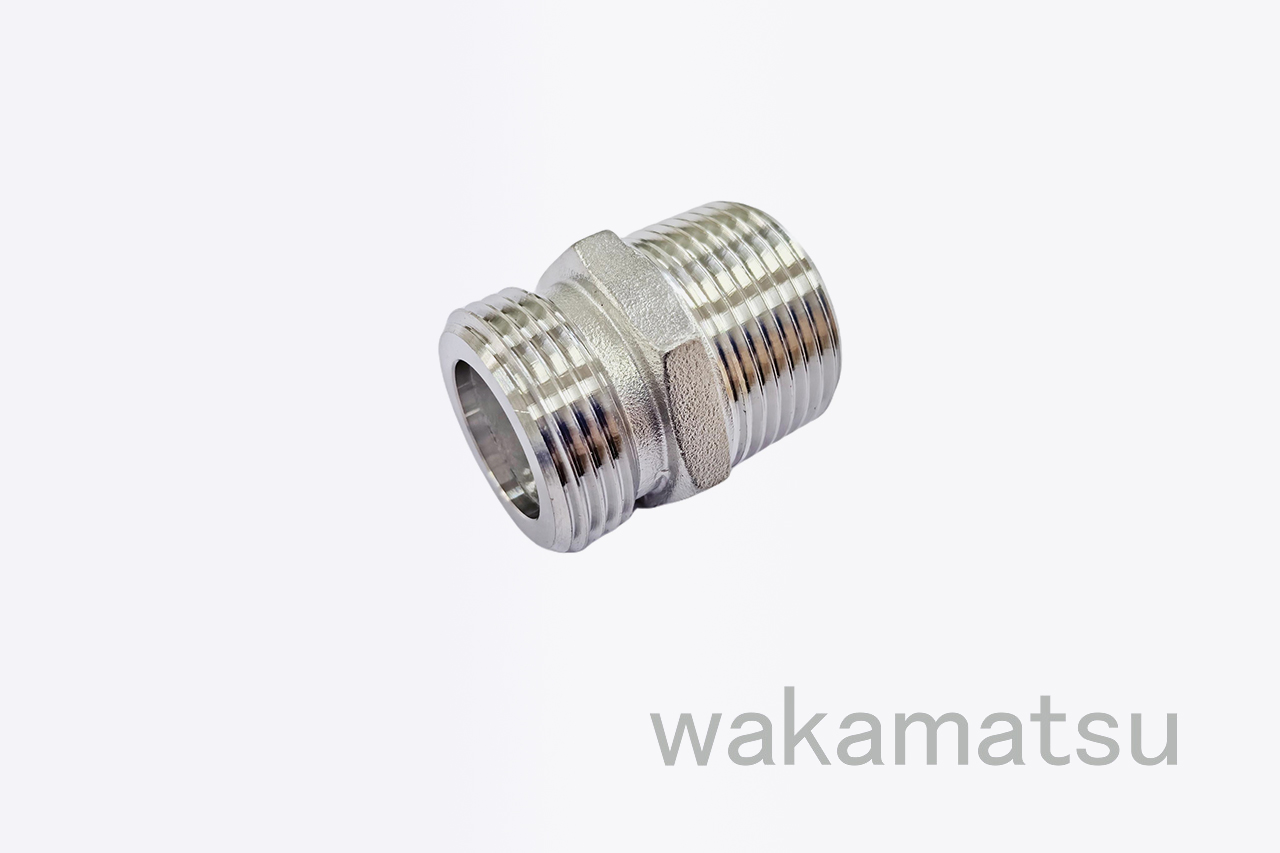 304 Stainless Steel Hexagonal Equal-Diameter Adapter for Threaded LinesThis hexagonal adapter from Shanghai Ruosung provides a compact transition between NPT ends in 304 stainless steel. It suits threaded piping systems where a vibration-resistant, corrosion-resistant connection is needed without welding.View Product →
Threaded stainless fittings demand disciplined assembly: apply anti-seize compound to prevent galling, tighten to the recommended torque for the thread size, and avoid over-tightening that distorts the threads. For a deeper look at thread compatibility, review our guide to choosing corrosion-resistant stainless steel threaded connectors.
Incoming Inspection Checklist for 304 Fittings
Inspect every batch before it enters the storeroom, and reject anything that fails traceability. This five-step check catches most nonconforming material before it becomes an installed failure.
- Verify the mill certificate against the grade marking on each fitting; confirm heat number, chemical composition, and mechanical test values.
- Measure outside diameter, inside diameter, wall thickness, socket depth, and center-to-end length against the applicable standard.
- Check the thread form with a go/no-go gauge for NPT or BSPT, and inspect thread surfaces for tearing or galling.
- Inspect surface finish under bright light; reject fittings with grinding marks, rust-colored tint, embedded iron, or pitting.
- Pressure-test a representative sample from each heat at 1.5 times the rated working pressure for critical service.
| Check | Tool or Method | Pass Criterion |
| Material traceability | Mill certificate review | Heat number matches stamping |
| Dimensions | Calipers, bore gauge | Within ASME B16.11 tolerance |
| Thread form | Go/no-go gauge | Fits within standard limits |
| Surface condition | Visual, bright light | No grinding marks, rust, or pits |
| Pressure integrity | Hydrostatic test | No leakage at 1.5x rating |
Weld defects are the leading cause of leakage in stainless piping that uses butt-welded joints. If your process depends on welded connections, the failure modes covered in our analysis of leakage caused by weld defects will help your procedure qualification cover the right defect types.
Grinding marks are a red flag. Mechanical abrasion destroys the passive layer and creates sites for chloride pitting. When in doubt, require a PMI test.
Building a Complete 304 System: Valves, Strainers, and Flanges
Fittings alone do not make a process line. Valves, flanges, and strainers must match the same grade, pressure class, and connection standard, or the weakest component defines the system limit.
In a 304 system, a stainless steel ball valve provides quarter-turn shutoff, but port configuration matters. Full-port valves minimize pressure drop and support pigging; reduced-port valves are lighter but increase flow velocity and erosion. Match the valve end connections to the fitting type: threaded ends for threaded fittings, socket-weld ends for socket-weld fittings, and butt-weld ends for full-weld lines.
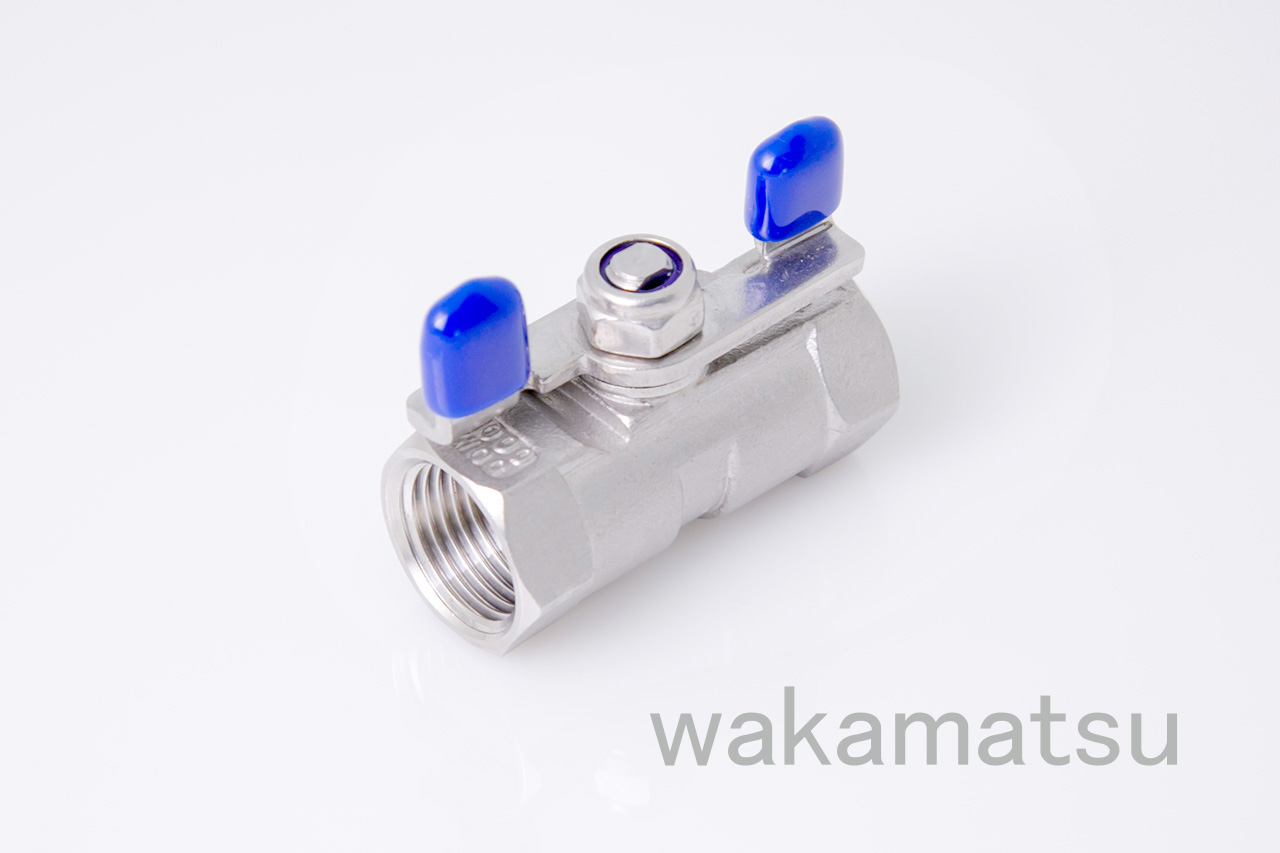 One-Piece Stainless Steel Ball Valve with Quarter-Turn ShutoffThis one-piece ball valve in stainless steel offers quarter-turn shutoff for 304 piping systems. With maximum pressure of 4.12 MPa and operating temperature from -20°C to 180°C, it suits water, oil, and gas applications.View Product →
Install a Y-type strainer upstream of each valve to protect seating surfaces from weld spatter, scale, and particulate debris. A 304 strainer with blowdown capability keeps the line clean without breaking connections. Verify flange class and gasket material together: a Class 150 flange paired with a Class 3000 fitting creates a mismatch that will leak long before the fitting reaches its rating.
Specify the same material, pressure class, and connection standard across fittings, valves, flanges, and strainers. The weakest link defines the system limit.
Frequently Asked Questions
What is the difference between 304 and 304L pipe fittings?
304L has a maximum carbon content of 0.03% versus 0.08% for 304. The lower carbon reduces chromium carbide precipitation during welding, so 304L is preferred for welded assemblies that will not receive post-weld heat treatment.
Can 304 stainless steel pipe fittings be used in seawater service?
Not for continuous immersion. 304 pits in chloride environments above roughly 100 ppm. For seawater or marine atmospheres, use 316L or a duplex grade with higher molybdenum content.
What is the pressure rating of 304 threaded fittings?
ASME B16.11 classifies threaded fittings as Class 2000, 3000, or 6000. A Class 3000 threaded coupling is rated at about 3000 psi cold working pressure at ambient temperature, derating to roughly 1800 psi at 300°C.
How can I verify that a fitting is really 304?
Require a mill test certificate with heat number, use a handheld X-ray fluorescence analyzer for quick grade verification, and confirm that the grade and heat code are permanently stamped on the fitting body.
Certificate Of Honor
If You Need More Help, Let Us Know.

ABOUT US
PRODUCTS
CAPABILITY
CONTACT US
- Phone: +86-21-59261529
- Email: sales@sh-wakamatsu.com
- Email: panhy@sh-wakamatsu.com
- Add: B3 Factory , Industrial Park, Jinze Town, Shanghai, China
Copyright © Shanghai Wakamatsu Metal Products Co., Ltd.
All Rights Reserved.Custom Stainless Steel Pipe Fitting Manufacturers, Suppliers