English
 日本語
日本語 中文
中文

Industry News
Home / News / Industry News / The Complete Guide to 316 Stainless Steel Pipe Fittings: Grades, Ratings, and Sizing
News
 Home / News / Industry News / The Complete Guide to 316 Stainless Steel Pipe Fittings: Grades, Ratings, and Sizing
The Complete Guide to 316 Stainless Steel Pipe Fittings: Grades, Ratings, and Sizing
 2026.09.30
 Industry News
Content
A coastal chemical plant in Eastern China tracked twelve 304 threaded unions failing within a single service year, all from pitting at the thread roots where chloride-laden process fluid had stagnated. The replacement order specified 316 stainless steel pipe fittings, and the same joints have logged four clean inspection cycles since. That outcome is predictable from alloy chemistry: 304 carries a pitting resistance equivalent number, or PREN, of roughly 19, while 316 with its 2-3% molybdenum sits between 24 and 26. This guide covers the metallurgy, pressure ratings, and connection standards you need to specify 316 pipe fittings correctly, plus the sourcing checks that keep counterfeit material out of your bill of materials.
The Metallurgy Behind 316 Stainless Fittings
The metallurgy of stainless steel pipe fittings separates them from the rest of the stainless catalog in one decisive way: a deliberate addition of 2-3% molybdenum.
316 stainless steel pipe fittings are pressure-containing connection components formed from an austenitic chromium-nickel-molybdenum alloy, typically 16-18% chromium, 10-14% nickel, and 2-3% molybdenum, with a pitting resistance equivalent number of 24-26.
Chromium forms the passive oxide layer that blocks general corrosion. Nickel stabilizes the austenitic microstructure, which keeps fittings ductile down to cryogenic temperatures. Molybdenum matters most for chloride service, because it reinforces the passive film at the microscopic breaks where pitting begins. Without that reinforcement, chloride ions penetrate the oxide layer and initiate localized corrosion that propagates quickly along grain boundaries.
316L, the low-carbon version with a maximum of 0.03% carbon, is the correct grade for welded assemblies. The reduced carbon prevents chromium carbide precipitation at the heat-affected zone, which in standard 316 can sensitize the weld area and leave it vulnerable to intergranular corrosion.
2-3% molybdenumraises pitting resistance by roughly 30% versus standard 304
Pressure Ratings for 316 Stainless Steel Pipe Fittings
The pressure limit of a 316 fitting is set by its weakest geometric feature, and for threaded designs that is almost always the thread root.
ASME B16.11 governs forged threaded and socket-weld fittings up to NPS 4 and assigns pressure classes of 2000, 3000, and 6000 psi. Butt-weld fittings manufactured to ASME B16.9 are rated by schedule thickness, with Schedule 80 commonly specified for higher-pressure process lines.
| Connection Type | Governing Standard | Pressure Class | 100F Rating | 400F Rating |
| Threaded | ASME B16.11 | Class 3000 | 2,220 psi | 1,860 psi |
| Threaded | ASME B16.11 | Class 6000 | 4,410 psi | 3,690 psi |
| Socket-Weld | ASME B16.11 | Class 3000 | 2,400 psi | 2,010 psi |
| Butt-Weld | ASME B16.9 | Schedule 80 | 2,750 psi | 2,300 psi |
2,220 psiClass 3000 threaded at 100F
4,410 psiClass 6000 threaded at 100F
80%allowable stress retained at 500F
1,500Fmax non-pressurized service temperature
Temperature derating for austenitic stainless steel starts above roughly 100F. At 500F, the allowable stress of 316 drops to about 80% of its room-temperature value. Never exceed the rating of the lowest-rated component in the assembly, because a Class 3000 fitting installed on a Class 6000 valve makes the fitting the weak link.
Fitting Types for 316 Stainless Steel Pipe Fittings
Each joining method trades speed, service pressure, and vibration resistance differently, so the fitting type should match the mechanical duty of the line.
Threaded Connectors
Threaded connectors dominate instrumentation and small-bore lines up to about NPS 2. They install quickly without heat, fit into tight spaces, and allow straightforward disassembly for maintenance. The trade-off is a stress concentration at the thread root and a seal path that depends on proper thread engagement plus sealant. The WSFG hexagonal equal-diameter adapter is a typical 316 threaded fitting for straight line transitions, and this guide to choosing corrosion-resistant stainless steel threaded connectors explains the selection trade-offs in detail.
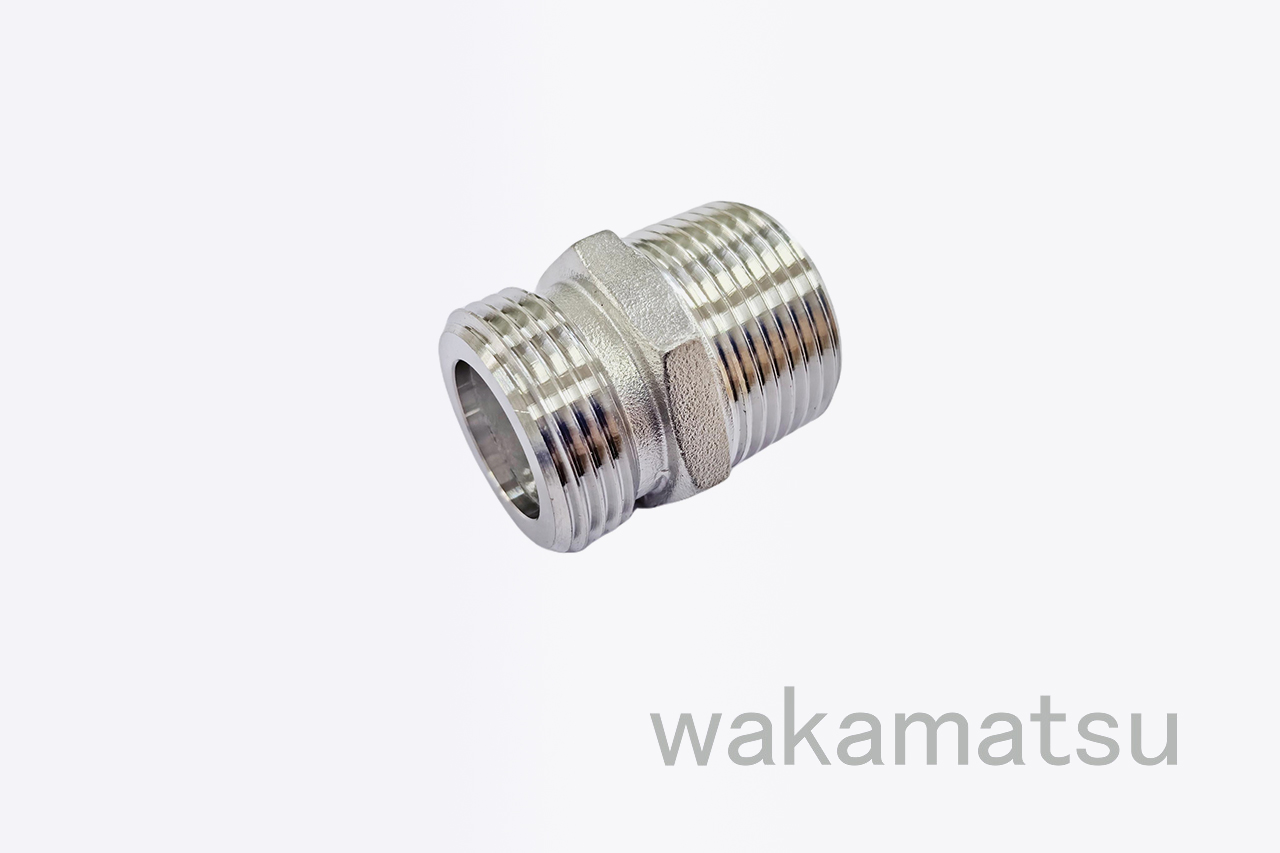 WSFG Stainless Steel Hexagonal Equal-Diameter AdapterThis threaded adapter suits straight line transitions in stainless steel piping, offering a corrosion-resistant 316 option for instrumentation and small-bore systems.View Product →
Bite-Type Fittings
Bite-type fittings create a metal-to-metal seal by compressing a hardened ferrule onto the tube surface. They tolerate vibration, survive repeated assembly cycles, and require no thread sealant. The W-KTC series is a widely specified 316 bite-type configuration for hydraulic and pneumatic circuits.
 W-KTC Stainless Steel Tube PlugA bite-type plug with dual-ferrule design and coated nut for repeated assembly, suitable for sealing tube ends in vibration-prone hydraulic and pneumatic circuits.View Product →
Butt-Weld Fittings
Butt-weld fittings are joined by full-penetration welding, which removes the thread-root stress concentration entirely. These are the preferred choice for high-pressure, high-temperature, or cyclic processes where a leak cannot be tolerated. A full overview of butt-weld fitting applications and benefits covers the weld preparation and inspection requirements.
NPT versus BSPT Thread Standards
NPT and BSPT look similar at a glance, but their 60-degree and 55-degree thread angles respectively mean they will not seal when mixed. Forcing an NPT male into a BSPT female produces galling, then leakage. Straight-thread standards such as NPSM or ISO 6149 seal with an O-ring rather than thread deformation and are common in hydraulic circuits.
| Standard | Thread Angle | Seal Method | Typical Region |
| NPT | 60 degrees | Thread deformation plus sealant | North America |
| BSPT | 55 degrees | Thread deformation plus sealant | UK, Europe, Asia |
| NPSM / parallel | 60 degrees | Gasket or O-ring | Hydraulic systems |
Corrosion Data That Should Drive Your Spec
The PREN formula puts numbers behind the 316-versus-304 debate. Both grades resist atmospheric oxidation, but the difference shows up only in environments that actually attack stainless steel.
In standardized 500-hour neutral salt spray tests, 304 commonly shows red rust at scribe marks while 316 retains its passive film. For welded lines, the low-carbon 316L variant closes the sensitization gap that would otherwise create a corrosion path along the weld.
304 Stainless
- 0% molybdenum
- PREN around 19
- Suitable for dry and mildly humid atmospheres
- Lower material cost
316 Stainless
- 2-3% molybdenum
- PREN 24-26
- Resists chloride pitting and seawater splash
- 20-30% price premium over 304
Sourcing 316 Stainless Steel Pipe Fittings with Traceability
Traceability is where many 316 specifications fail. The alloy content on the invoice means nothing if the physical material does not carry a matching mill certificate.
- Mill test certificate with heat number matching the marking on each fitting
- Chemical composition within ASTM A403 for butt-weld fittings or ASTM A182 for forged threaded and socket-weld fittings
- ISO 9001-certified production facility with documented inspection records
- Surface inspection for pitting, die marks, or embedded contaminants
Shanghai Ruosung Metal Products Co., Ltd., a Japanese-owned manufacturer established in 2003, produces 316 stainless steel fittings, valves, and flanges at its 9,400-square-meter facility in the Yangtze River Delta region, with ISO 9001 certification held since 2008. The product line covers threaded connectors, bite-type fittings, quick connectors, VCR connectors, ball valves, and flanges, all export-grade and shipped to Japan, Europe, the Americas, and Southeast Asia.
Complete the system with a ball valve that matches the fittings. The WV101 series is a 316 stainless ball valve commonly paired with 316 threaded pipe in chemical dosing and cooling-water circuits.
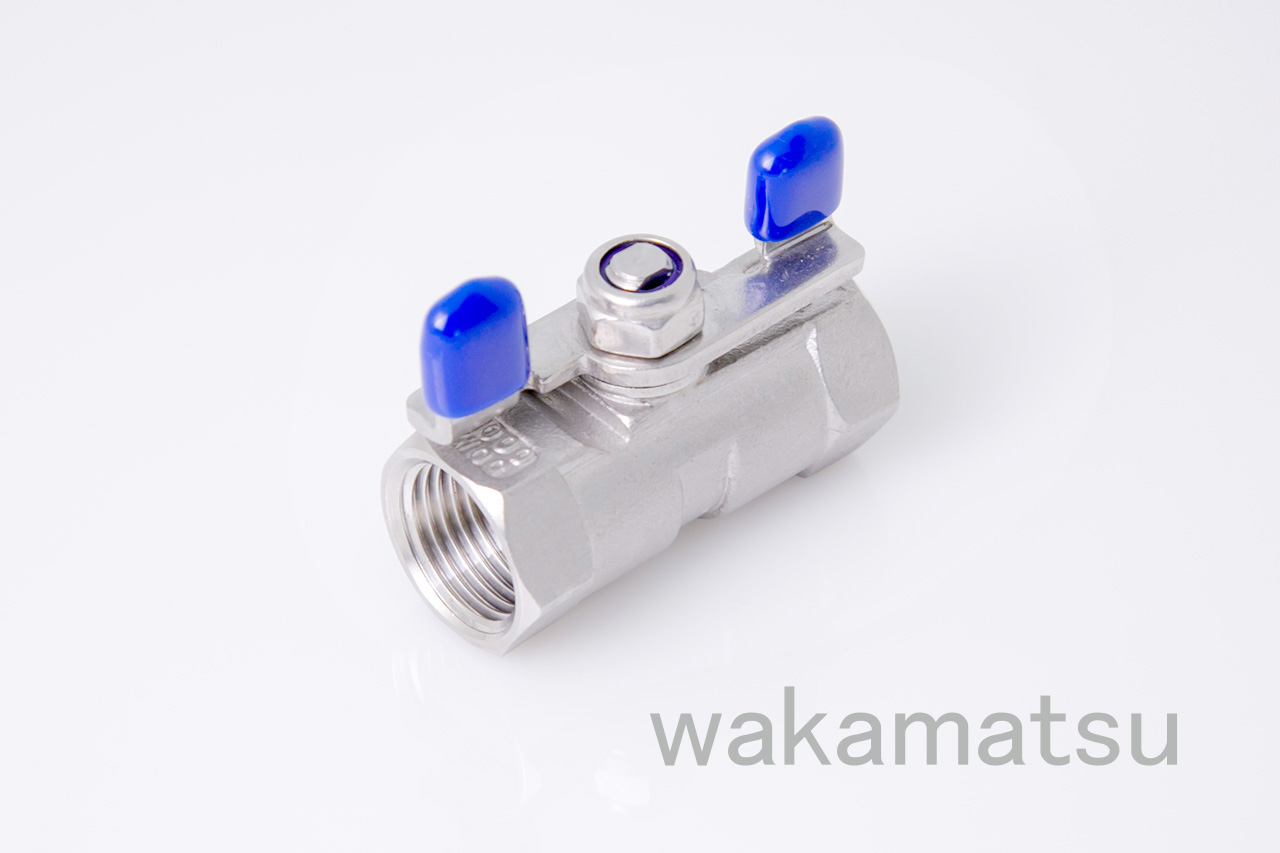 WV101/WV101B Stainless Steel One-Piece Ball ValveThis compact ball valve pairs with threaded piping for chemical dosing and cooling-water circuits, rated for water, oil, and gas service up to 4.12 MPa.View Product →
Frequently Asked Questions
What is the difference between 316 and 316L stainless steel pipe fittings?
The L stands for low carbon content at 0.03% maximum, compared to 0.08% for standard 316. That reduction prevents chromium carbide precipitation during welding, so 316L resists intergranular corrosion in the heat-affected zone. For welded systems, specify 316L rather than 316.
Are 316 stainless steel pipe fittings suitable for seawater service?
316 handles splash zones, tidal exposure, and many brackish-water circuits, but continuous immersion in quiet seawater can produce crevice corrosion under gaskets, scale deposits, or biofilms. For permanent submerged service, duplex grades such as 2205 or super-austenitic alloys are safer choices.
How can I verify that a fitting is genuine 316 rather than 304?
Check the permanent grade marking and cross-reference it with a mill test certificate carrying the same heat number. Run positive material identification (PMI) with a handheld XRF analyzer on a sample; the analyzer detects the molybdenum peak that distinguishes 316 from 304.
Are 316 fittings interchangeable with 304 in an existing line?
Mechanically, yes, because 316 and 304 share the same dimensional standards and pressure classes. Corrosion-wise, the existing 304 pipe or fittings will limit overall performance, so upgrading only the fittings does not upgrade the whole line.
Specifying 316 stainless steel pipe fittings correctly means matching the alloy to chloride exposure, the fitting type to mechanical duty, and the thread standard to the rest of the system. Verify every lot with a mill certificate and confirm the ISO 9001 provenance of the supplier, and the fittings will outlast the rest of the line.
Certificate Of Honor
If You Need More Help, Let Us Know.

ABOUT US
PRODUCTS
CAPABILITY
CONTACT US
- Phone: +86-21-59261529
- Email: sales@sh-wakamatsu.com
- Email: panhy@sh-wakamatsu.com
- Add: B3 Factory , Industrial Park, Jinze Town, Shanghai, China
Copyright © Shanghai Wakamatsu Metal Products Co., Ltd.
All Rights Reserved.Custom Stainless Steel Pipe Fitting Manufacturers, Suppliers