English
 日本語
日本語 中文
中文

Industry News
Home / News / Industry News / 304 Stainless Steel Tube Fittings: Threaded vs Bite-Type vs Butt-Weld Guide
News
 Home / News / Industry News / 304 Stainless Steel Tube Fittings: Threaded vs Bite-Type vs Butt-Weld Guide
304 Stainless Steel Tube Fittings: Threaded vs Bite-Type vs Butt-Weld Guide
 2026.10.07
 Industry News
Content
- 1 Why 304 Stainless Steel Tube Fittings Are the Default in Industrial Piping
- 2 Threaded, Bite-Type, or Butt-Weld: Which 304 Stainless Steel Tube Fittings Fit Your Line
- 3 Matching 304 Stainless Steel Tube Fittings to Pressure, Temperature, and Vibration
- 4 Four Failure Modes That Take Stainless Steel Fittings Offline
- 5 What a Reliable Supplier Must Deliver
- 6 Frequently Asked Questions
A pharmaceutical plant in Jiangsu lost eight hours of production when a 1/4-inch 304 stainless steel tube fitting started weeping on a nitrogen header during a 180-bar hydrostatic test. The crew re-torqued the threads, replaced the ferrule, then cut the line and welded a stub-in: three different fixes for one connection. That scene repeats wherever plant engineers treat 304 stainless steel tube fittings as a commodity. They are not. The term covers threaded, bite-type, butt-weld, and quick-connect families with different pressure limits, leak paths, and labor costs. This guide explains how to select 304 stainless steel tube fittings by service conditions, what ratings to verify before purchase, and which failures pull fittings out of service fastest.
Why 304 Stainless Steel Tube Fittings Are the Default in Industrial Piping
304 stainless steel tube fittings are the default for general industrial service because 18 percent chromium and 8 percent nickel deliver dependable corrosion resistance at roughly one-third of the raw-material cost of 316. For instrument lines, pneumatic controls, hydraulic systems, medical gas, and plant utilities, that cost-to-corrosion balance beats every alternative.
The mechanical numbers back the choice. A 304 fitting machined from bar or forging stock typically reaches at least 515 MPa tensile strength, 205 MPa yield strength, and hardness under 90 HRB, with usable service from about -196 degrees C up to roughly 425 degrees C. Those margins are why small-bore 304 fittings can carry working pressures above 400 bar without fatigue.
The limit is chloride stress corrosion cracking. When chlorides concentrate above roughly 200 ppm at temperatures above 60 degrees C, cracks initiate at thread roots and ferrule grooves. For coastal process plants, marine hydraulics, or bleach service, the correct move is 316L or a duplex grade, not a thicker-wall 304 fitting.
Threaded, Bite-Type, or Butt-Weld: Which 304 Stainless Steel Tube Fittings Fit Your Line
Connection type decides pressure capability, leak integrity, and maintenance cost before any other variable: bite-type 304 stainless steel tube fittings hold about 400 bar in 1/4-inch tubing, threaded connectors suit 1/8-inch to 4-inch lines to roughly 200 bar, and butt-weld joints reach full pipe strength with no mechanical seal that can wear.
Threaded 304 fittings are the lowest-cost way to build a network around valves, gauges, and manifolds. NPT and BSPT tapered threads seal by metal deformation at the crests, which creates a torque window rather than a single torque number: too little torque leaks, too much torque galls the threads and scraps the fitting. Above 2-inch size, or where vibration is continuous, tapered threads should not be the primary joint.
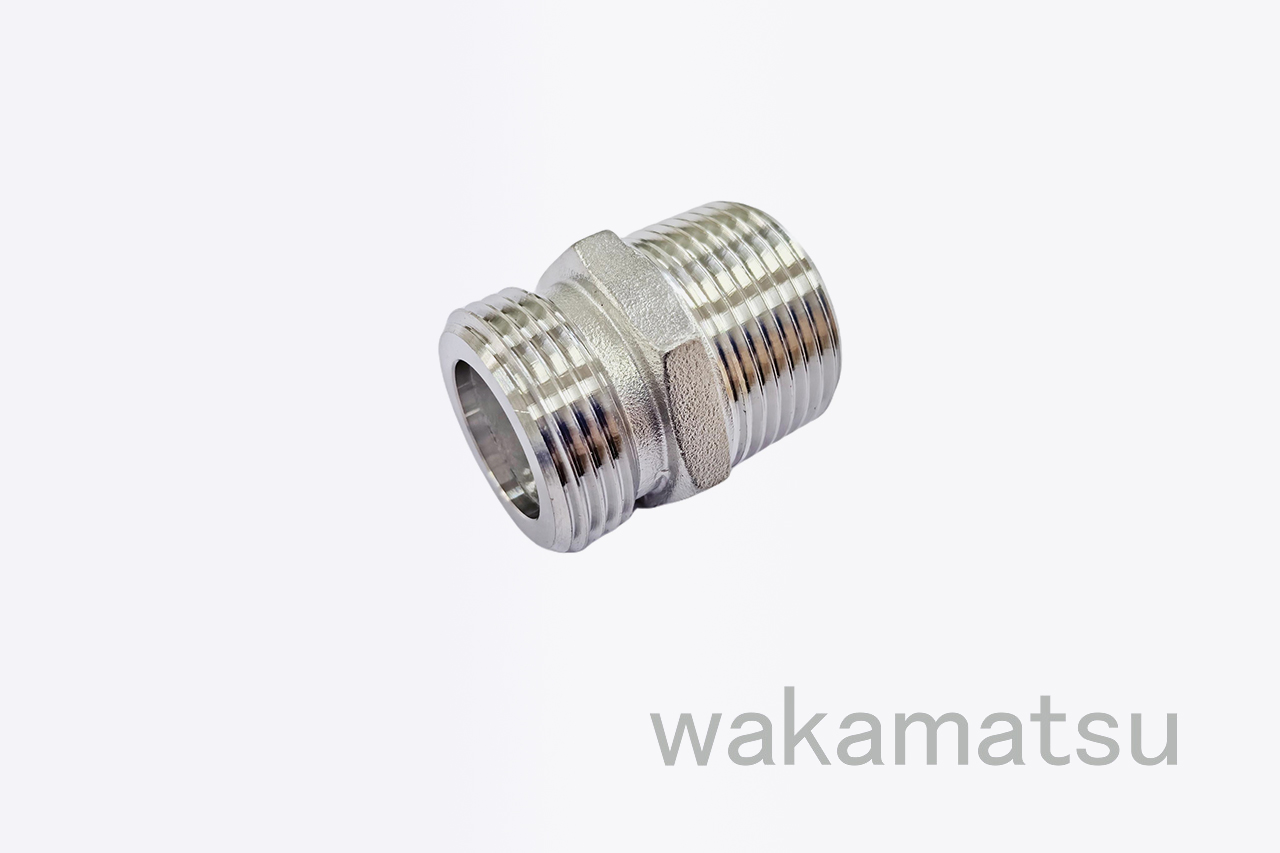 WSFG Stainless Steel Hexagonal Equal-Diameter AdapterThis adapter suits threaded 304 fitting networks where tapered threads need a reliable transition; its smooth G-thread sealing surface addresses the torque and galling concerns raised in the discussion.View Product →
A bite-type fitting is a mechanical joint that seals by pressing a hardened ferrule into a concentric groove cut into the outside of the tube wall. Bite-type 304 fittings handle higher pressure and vibration than threaded joints and can be remade several times. The catch is dimensional sensitivity: a 1/4-inch bite-type fitting rated to 400 bar assumes a specific tube wall thickness, hardness, and surface finish.
 W-Ktc Stainless Steel Tube Plug with Dual Ferrule DesignA live-load, dual-ferrule tube plug that complements bite-type fittings, offering repeated disassembly and reuse while maintaining seal integrity in higher-pressure vibration-sensitive tube systems.View Product →
Butt-weld 304 fittings have no threads, no ferrules, and no leak path except the weld itself. They dominate high-pressure, high-temperature, and hygienic lines where dead space is unacceptable. The trade-off is a certified welder, argon purge, and post-weld passivation; a defective weld leaks more than a good thread.
| Attribute | Threaded | Bite-type | Butt-weld | Quick-connect |
| Typical size range | 1/8 to 4 in. | 1/16 to 1 in. | 1/4 to 12 in. and up | 1/8 to 1 in. |
| Max working pressure, 1/4-in. tube | ~200 bar | ~400 bar | ~500 bar | ~100 bar |
| Primary leak path | Thread helix | Ferrule grip | Weld seam | O-ring or seal |
| Assembly skill | Medium | Low to medium | Certified welder | Low |
| Remake or dismantle | Yes | Yes | No, cut out | Yes |
| Vibration resistance | Moderate | High | Highest | Moderate |
Max working pressure of 304 tube fitting connections, 1/4-inch tubing
Bite-type
400 bar
Butt-weld
500 bar
Threaded NPT
200 bar
Quick-connect
100 bar
Typical general-purpose ratings. Verify against the manufacturer's pressure certificate for the exact tube wall and temperature.
Choose threaded fittings when
- The line already has NPT or BSPT ports
- Sizes run from 1/2 to 4 inches
- The crew can re-cut threads on site
- Budget is tighter than downtime risk
Choose bite-type fittings when
- Pumps or compressors create vibration
- Joints are remade more than twice a year
- Tubing is 1/16 to 3/8 inch instrument line
- Hot work permits are hard to obtain
Matching 304 Stainless Steel Tube Fittings to Pressure, Temperature, and Vibration
Select 304 stainless steel tube fittings by three measurable service parameters, pressure, temperature, and dynamic load, because each parameter eliminates at least one connection type. Pressure decides wall thickness and ferrule class. Temperature derates the pressure rating: a 304 fitting rated for 100 bar at 20 degrees C typically drops to about 70 percent of that rating at 400 degrees C. Vibration is the hidden killer: a threaded joint under a 10-Hz pulsation backs off within weeks, while a bite-type or welded joint holds for years.
~400 barWorking pressure for 1/4-inch bite-type fittings with the specified tube wall
-196 to 425 deg CPractical range for 304 fittings, derating above roughly 300 deg C
~200 ppm Cl-Chloride threshold above which 316L is the safer material at 60 deg C
Three specification details buyers forget
- Tube wall thickness. A bite-type fitting calibrated for a 1.5-mm wall will not seal on 2.0-mm tube; the ferrule cannot cut deep enough and the joint leaks at working pressure.
- Thread form. NPT and BSPT are both tapered but not interchangeable; mixing them creates a leak that is usually blamed on the fitting.
- Surface finish. Electropolished 304 fittings are specified for pharmaceutical and semiconductor lines; a standard 180-grit finish traps particles and bacteria.
For filter changes and gas panels opened on a fixed schedule, quick-connect 304 fittings with a metal gland and elastomer seal cut maintenance time below what wrench work allows.
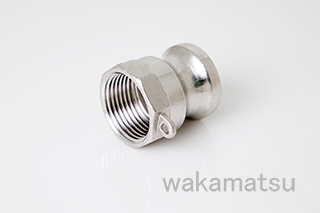 W-Ksa Stainless Steel Quick Connector for Maintenance AccessDesigned for filter changes and gas panels on fixed schedules, this quick connector reduces wrench time, aligning with the paragraph's emphasis on faster maintenance while remaining a corrosion-resistant 304 option.View Product →
For threaded assemblies, the full selection logic, including coatings, anti-seize, and corrosion limits, is detailed in our guide to corrosion-resistant stainless steel threaded connectors.
Four Failure Modes That Take Stainless Steel Fittings Offline
Four causes produce most unplanned failures in 304 stainless steel tube fittings: thread galling, chloride stress corrosion cracking, weld defects, and vibration loosening. Each has a known prevention, so recurring leaks are a design problem, not a parts problem.
- Thread galling. Bare 304 threads cold-weld to each other under friction and seize within seconds at assembly torque. Use a copper- or nickel-based anti-seize, torque within the manufacturer's window, and discard any thread that has scored.
- Chloride stress corrosion cracking. Cracks begin at thread roots and ferrule grooves when chlorides exceed about 200 ppm and temperature stays above 60 degrees C. Move to 316L or duplex for continuous chloride service.
- Weld defects. Lack of fusion, burn-through, and heat tint create micro leak paths that visual inspection misses. Purge with argon, use qualified welders, and pressure-test every joint; the mechanics are covered in our article on leakage caused by weld defects.
- Vibration loosening. A threaded fitting on a pump discharge line sees cyclic stress and backs off even with sealant. Switch to a bite-type or welded connection, clamp the tubing every 24 inches, and audit torque on critical joints.
Rule of thumb: if a fitting has been remade twice and still weeps, stop re-torquing and change the connection type. The fitting is not the problem; the joint design is.
What a Reliable Supplier Must Deliver
Material certificates and quality systems matter more than piece price because a batch of 10,000 fittings with inconsistent thread tolerance shows up in the field a year later as leaks and rework. Shanghai Wakamatsu Metal Products Co., Ltd. (cn-wakamatsu.com) has machined stainless steel fittings since 2003 in a 9,400-square-meter facility with CNC centers and has held ISO 9001 certification since 2008, with engineers trained in Japanese manufacturing methods.
Before you award a tube-fitting order, confirm three things:
- Material traceability: a mill certificate with the heat number for every batch, especially for medical gas and fire protection systems.
- Dimensional tolerance: thread class 2A/2B per ASME B1.20.1 and documented ferrule hardness for bite-type lines.
- Export discipline: suppliers that ship regularly to Japan, Europe, the Americas, and Southeast Asia have already solved the packaging and documentation issues that delay startups.
A 304 fitting is only as good as the system that made it: CNC-controlled geometry, certified material, and batch traceability. Shanghai Wakamatsu holds the first two in-house and documents the third on every order.
Frequently Asked Questions
Can 304 stainless steel tube fittings handle seawater?
Not for continuous seawater contact. Seawater runs about 19,000 ppm chlorides, far above the roughly 200 ppm threshold where chloride stress corrosion cracking starts at 60 degrees C. Specify 316L, duplex, or a higher-PRE alloy for marine service.
What is the maximum pressure for a bite-type 304 fitting?
For 1/4-inch OD tube with the specified wall thickness, general-purpose bite-type fittings are rated around 400 bar (5800 psi). The rating falls with larger size, thinner wall, and higher temperature; verify against the manufacturer's test certificate rather than the catalog cover.
Why do stainless steel threads gall and how do I prevent it?
Galling is localized cold welding of thread surfaces under friction and pressure. Prevent it with a stainless-rated anti-seize compound, controlled torque, and clean threads that have never been scored.
What temperature range is acceptable for 304 fittings?
304 fittings are normally acceptable from about -196 degrees C to 425 degrees C in continuous service, with pressure derating above roughly 300 degrees C. Above that range, creep becomes a concern and stabilized grades such as 321 or 347 are safer.
Related Products
Certificate Of Honor
If You Need More Help, Let Us Know.

ABOUT US
PRODUCTS
CAPABILITY
CONTACT US
- Phone: +86-21-59261529
- Email: sales@sh-wakamatsu.com
- Email: panhy@sh-wakamatsu.com
- Add: B3 Factory , Industrial Park, Jinze Town, Shanghai, China
Copyright © Shanghai Wakamatsu Metal Products Co., Ltd.
All Rights Reserved.Custom Stainless Steel Pipe Fitting Manufacturers, Suppliers