English
 日本語
日本語 中文
中文

Industry News
Home / News / Industry News / Stainless Steel Flexible Hose Joint: A Complete Selection and Installation Guide
News
 Home / News / Industry News / Stainless Steel Flexible Hose Joint: A Complete Selection and Installation Guide
Stainless Steel Flexible Hose Joint: A Complete Selection and Installation Guide
 2026.10.14
 Industry News
Content
Every rigid stainless steel pipe joint has a fatigue limit, and vibration will find it. In a chemical process line carrying 160°C steam at 14 bar, a hard-mounted 316L threaded connection typically develops stress cracks within six to twelve months when the line moves 3 to 5 mm under thermal cycling. Replacing that rigid section with a stainless steel flexible hose joint — a corrugated bellows reinforced with woven wire braid — absorbs the displacement and pushes service life past five years in most installations.
This guide covers what a stainless steel flexible hose joint is, how to select the correct size and pressure rating, and how to install it without introducing new failure modes. The principles apply to process piping, water treatment, HVAC, and general industrial equipment where vibration, thermal expansion, or minor misalignment is present.
What Is a Stainless Steel Flexible Hose Joint?
A stainless steel flexible hose joint is a pressure-containing assembly made of a corrugated metal bellows, a reinforcing wire braid, and end connectors, engineered to absorb axial, lateral, and angular movement without transmitting bending loads into adjacent rigid pipework.
Three elements define the joint, and each one earns its place under load:
- Corrugated bellows. The thin-walled convoluted core that bends, extends, and compresses. Bellows are formed from 304 or 316L strip at 0.2 to 0.5 mm wall thickness, which keeps the spring rate low enough for normal piping loads to flex the joint freely.
- Wire braid. One or two layers of stainless steel wire wrapped around the bellows. The braid restrains internal pressure and prevents over-extension, and it carries most of the axial load at working pressure.
- End fittings. Threaded, butt-weld, flanged, or quick-connect ends that join the assembly to the pipe. The fitting alloy should match or exceed the bellows grade so the connection does not become the weak point.
Definition
A stainless steel flexible hose joint is a flexible connector that uses a corrugated metal bellows and wire braid to absorb movement in a pressurized pipe while maintaining a leak-tight seal.
Shanghai Ruosung Metal Products offers these assemblies as machined, fully welded flexible pipe joints in common bore sizes from DN08 to DN100, with each size matched to a specific braid configuration and end fitting.
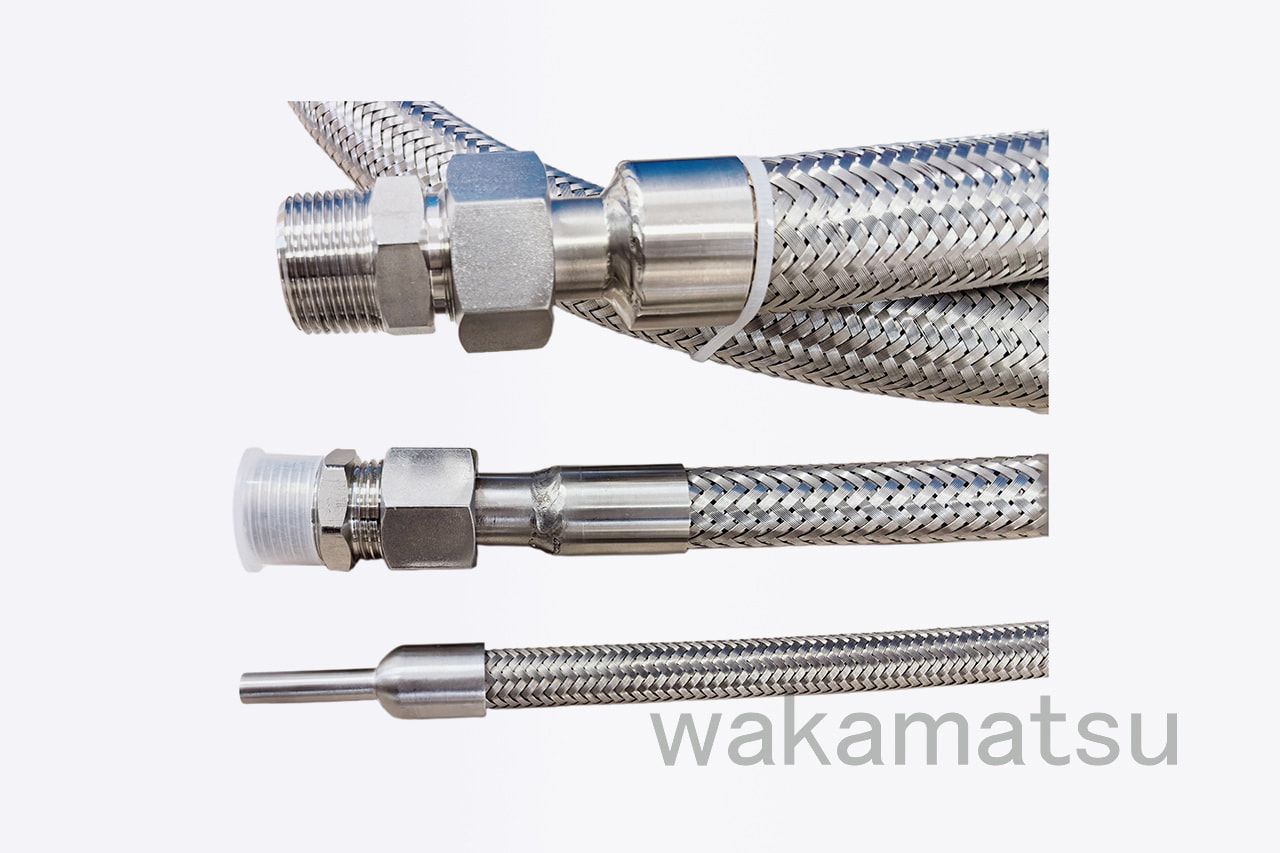 Stainless Steel Flexible Pipe Joints with Braided BellowsThese welded flexible pipe joints compensate for axial, lateral, and angular movement in piping. Bore sizes from DN08 to DN100 match specific braid and end fittings, making them suitable for pump and valve outlets.View Product →
How to Select the Right Stainless Steel Flexible Hose Joint
Selection starts by measuring the movement the joint must absorb — axial travel, lateral offset, and angular deflection — because the required length and rated travel come from those numbers, not from the pipe size alone.
Measure the movement first
Record three values: axial compression or extension along the pipe axis, lateral offset perpendicular to the axis, and angular deflection at the joint. If total movement is below 3 mm, a rigid fitting may be sufficient. Above that, a flexible joint is justified by the fatigue life it adds to the adjacent pipe and equipment.
Size the bore and match the end connection
For liquid and steam lines, the flexible joint bore should match the pipe bore to avoid velocity jump, erosion, and pressure drop. End connections follow the existing system: BSPT or NPT threads for small-bore lines, butt weld for high-integrity process lines, and flanges where maintenance access matters. Hose connectors follow the same logic — the joint is only as reliable as the fitting that mates it to the line.
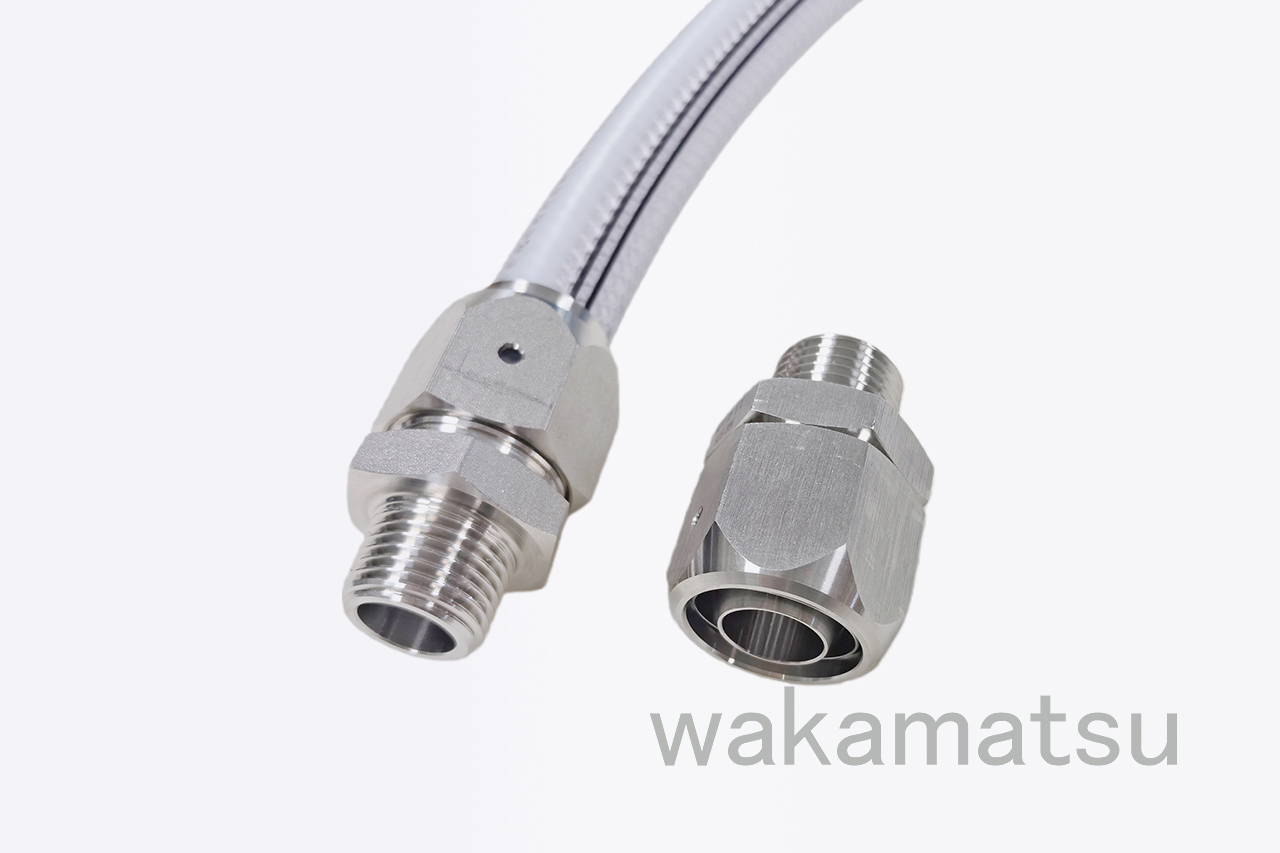 Stainless Steel and Carbon Steel Hose ConnectorsThese hose fittings offer threaded, flanged, or quick-connect options for hydraulic, pneumatic, and water lines. Precision machining and quality seals provide leak-proof, pull-out-resistant connections that match your existing system.View Product →
Apply the temperature derating
Rated working pressure is stated at 20°C. At 200°C the rating drops to roughly 80 percent of the ambient value; at 350°C it drops to about 60 percent. A joint rated at 25 bar at room temperature behaves as a 15 bar joint at 350°C. For saturated steam, keep wet-steam corrosion limits in mind — 304 bellows tolerate moderate steam service, while 316L is the safer default for chlorides or cyclic condensation.
DN08–DN100Standard bore range
-20 to 400°CTypical service temperature
4:1Burst-to-working ratio
| Nominal bore | Working pressure at 20°C | Min. dynamic bend radius | Typical application |
| DN15 | 36 bar | 180 mm | Instrument lines |
| DN20 | 30 bar | 220 mm | Small pump connections |
| DN25 | 24 bar | 280 mm | Compressor discharge |
| DN32 | 18 bar | 350 mm | Process water |
| DN40 | 14 bar | 420 mm | Steam tracing |
| DN50 | 10 bar | 500 mm | Main headers |
Working pressure falls as bore size grows
Single-braid 316L bellows, wet rating at 20°C with a 4:1 burst safety factor.
Installation Best Practices for Stainless Steel Flexible Hose Joints
Most premature failures in stainless steel flexible hose joints come from installation mistakes, not from manufacturing defects — and the most common error is twisting the joint into position with a wrench instead of aligning the pipe first.
- Measure the actual movementVerify axial and lateral travel in millimeters before mounting. A joint sized for 20 mm of travel will fail early if the line actually moves 30 mm.
- Square and deburr all tube endsFor weld-end joints, the gap between tube and fitting governs weld quality. Porosity or lack of fusion at the end-fitting weld produces pinhole leaks independent of bellows quality — the same pattern described in our field notes on leakage caused by weld defects.
- Align the pipe ends before tighteningNever pull a misaligned flange into place with the joint bolts. That loads the bellows in torsion and reduces fatigue life more than any other single error.
- Tighten to torque, not to habitThreaded ends need a torque wrench; over-tightening crushes the braid at the ferrule and chokes the bellows.
- Block abrasion pointsIf the braid can touch a steel support, install a guard or reposition the joint so the braid is free. Vibration against a sharp edge cuts braid wires one at a time.
Aligned installation
- Joint runs straight at rest
- Corrugations uniform, no flattening
- Braid smooth, no bright wear patch
Misaligned installation
- Joint curved under residual load
- Bellows flattened on one side
- Polished spot on the braid
The hoses and flexible pipes section of the Shanghai Ruosung catalog carries complete assemblies in matching alloys, so you can select the braid layer and end fitting together rather than mixing parts from different suppliers.
Stainless Steel Hose Connectors and Flexible Pipe JointsThis range of flexible assemblies includes stainless steel, PTFE, and rubber constructions for dynamic flexing, vibration absorption, and high-temperature service. Matching alloys for braid and end fittings simplify selection and reduce mismatch risks.View Product →Common Failure Modes and How to Prevent Them
The four most common field failures in stainless steel flexible hose joints are bellows fatigue, braid abrasion, torsion damage, and over-extension — and each one leaves a visual signature before it leaks, which means scheduled inspection can catch all four.
| Failure mode | Visual signature | Primary cause | Prevention |
| Bellows fatigue | Pinhole cracks at corrugation roots | Travel beyond rated limits | Specify a longer joint |
| Braid abrasion | Polished or broken wires on one side | Rubbing on adjacent steelwork | Add a braid guard |
| Torsion damage | Twisted corrugations, wrinkles | Flange misalignment at install | Align before tightening |
| Over-extension | Loss of corrugation, flat bellows | Pipe anchor shifted | Fit limit rods |
65%
of metal bellows failures in rotating equipment are traced to installation and selection errors; material defects account for under 15 percent.
Inspection frequency depends on service: monthly for steam and rotating equipment, quarterly for ambient-temperature water lines. Look for broken braid wires first, then bellows surface condition, then end-fitting welds.
Frequently Asked Questions About Flexible Hose Joints
How long does a stainless steel flexible hose joint last?
A correctly installed single-braid 316L joint in moderate-pressure water or steam service typically lasts five to ten years. Life drops sharply when the joint operates beyond its rated travel, above its temperature derating, or in a torsionally loaded condition.
Can a stainless steel flexible hose joint handle steam?
Yes. Single-braid 304 and 316L bellows assemblies are commonly rated for saturated steam up to 180°C at 10 bar. For higher pressures or frequent cycling, specify a multi-ply bellows or an externally pressurized design, and verify the temperature derating before purchase.
What is the minimum bend radius for a flexible hose joint?
The minimum dynamic bend radius is typically 10 to 15 times the nominal bore. For a DN25 joint, that means at least 250 to 300 mm in service. Static installations can use a slightly tighter radius, but never below the value printed on the joint tag.
How do I know when to replace a flexible hose joint?
Replace the joint when you find cracked braid wires, flattened bellows, corrosion pits on the bellows wall, or weeping at the end fittings. Any of these signs means the pressure boundary is already compromised; waiting for a visible leak turns a planned swap into an emergency shutdown.
Inspection rule
Check the braid before the bellows: broken wire strands appear months before leaks do, and they are visible without removing the joint from the line.
Certificate Of Honor
If You Need More Help, Let Us Know.

ABOUT US
PRODUCTS
CAPABILITY
CONTACT US
- Phone: +86-21-59261529
- Email: sales@sh-wakamatsu.com
- Email: panhy@sh-wakamatsu.com
- Add: B3 Factory , Industrial Park, Jinze Town, Shanghai, China
Copyright © Shanghai Wakamatsu Metal Products Co., Ltd.
All Rights Reserved.Custom Stainless Steel Pipe Fitting Manufacturers, Suppliers