English
 日本語
日本語 中文
中文

Industry News
Home / News / Industry News / How to Select and Install Industrial Stainless Steel Flexible Pipe Joints
News
 Home / News / Industry News / How to Select and Install Industrial Stainless Steel Flexible Pipe Joints
How to Select and Install Industrial Stainless Steel Flexible Pipe Joints
 2026.09.09
 Industry News
Content
- 1 Why Stainless Steel Flexible Pipe Joints Are the First Fix for Pipe Fatigue
- 2 Types of Stainless Steel Flexible Pipe Joints and Their Movement Ratings
- 3 Selection Criteria: Pressure, Temperature, Media, and Movement
- 4 Installing Stainless Steel Flexible Pipe Joints by Field Rules
- 5 Quality Risks When Buying Stainless Steel Flexible Pipe Joints
- 6 Frequently Asked Questions About Flexible Pipe Joint Selection
On the discharge side of a 45 kW centrifugal pump, a six-metre run of Schedule 40 stainless steel pipe cracked twice in eight months at the welded support lugs. Vibration from the pump impeller, not internal pressure, was driving the fatigue. The plant replaced the rigid spool with a stainless steel flexible pipe joint, and the next two-year inspection came back clean. This is the standard remedy for pipe fatigue caused by vibration, thermal expansion, and minor misalignment in industrial lines.
Shanghai Ruosung Metal Products Co., Ltd., a Japanese-invested manufacturer established in 2003, supplies these connectors to pump stations, compressor packages, HVAC risers, marine piping, and fire-suppression systems. Its engineers work to Japanese shop practice and ISO 9001 procedures, and the product range covers flexible pipe joints, hose connectors, bite-type fittings, threaded connectors, valves, and flanges. This guide explains how stainless steel flexible pipe joints work, how to rate them, and where field failures actually originate.
A stainless steel flexible pipe joint is a movement-absorbing connector built around a corrugated stainless bellows or an interlocked hose core, generally reinforced with one or two stainless braid layers. It absorbs axial compression and extension, lateral offset, and angular rotation without transferring those loads into the connected equipment.
A ten-metre Type 304 stainless steel pipe heated from 20 degrees C to 120 degrees C grows 17 mm in length. A single flexible pipe joint rated for axial movement absorbs that growth without pushing a pump flange out of alignment.
17.2 um/(m.K)linear expansion coefficient of Type 304 stainless steel
+/-15 mmtypical axial rating for a DN50 bellows joint
10 000design cycles per EJMA fatigue curves for a well-built bellows
-200 to 400practical service band in degrees C for 304/316 bellows
Values calculated from the 17.2 um/(m.K) expansion coefficient of Type 304 stainless steel.
Why Stainless Steel Flexible Pipe Joints Are the First Fix for Pipe Fatigue
Piping fatigue in stainless lines is driven by cyclic strain, not by steady pressure. Every pressure pulse, pump stroke, or thermal cycle bends the pipe; when that bending concentrates at a weld toe, thread root, or flange face, cracks form after thousands of cycles. A flexible joint moves the strain into the bellows convolution, where it is designed to be absorbed elastically.
Stainless steel is more demanding than carbon steel because its expansion coefficient is about 40 percent higher and it conducts vibration with low damping. Rigid stainless runs near reciprocating equipment therefore need a compliance point.
- Pump discharge and suction lines: isolate the pump casing from pipe reaction forces.
- Compressor and blower packages: absorb pulsation and thermal swing on every start-stop cycle.
- Steam and hot-water headers: take up differential movement between equipment and building structure.
- Skid-mounted modules: simplify final tie-in alignment between prefabricated pipe sections.
Rule of thumb
A flexible joint belongs wherever a rigid line would transmit more than 75 percent of the allowable nozzle load into a pump or compressor, or where the calculated thermal growth between two fixed points exceeds 5 mm.
Types of Stainless Steel Flexible Pipe Joints and Their Movement Ratings
Four constructions dominate industrial stainless steel flexible pipe joints, each with a different movement envelope and pressure ceiling. Choosing correctly between them saves more money than any other single decision in the piping design.
| Construction | Movement absorbed | Typical pressure | Best service |
| Corrugated hose, single braid | Lateral and bending | Up to 40 bar at DN50 | Pump connectors, skid tie-ins |
| Bellows joint with tie rods | Axial and lateral | 6 to 25 bar | Hot headers, thermal loops |
| Double-braided flexible connector | Vibration and minor offset | Up to 210 bar small bore | Hydraulic and high-pressure lines |
| Interlocked strip-wound hose | Free bending, no torsion | Vacuum to 10 bar | Exhaust, vent, abrasive handling |
Flanged flexible pipe joints are the most common pump-side component in this category.
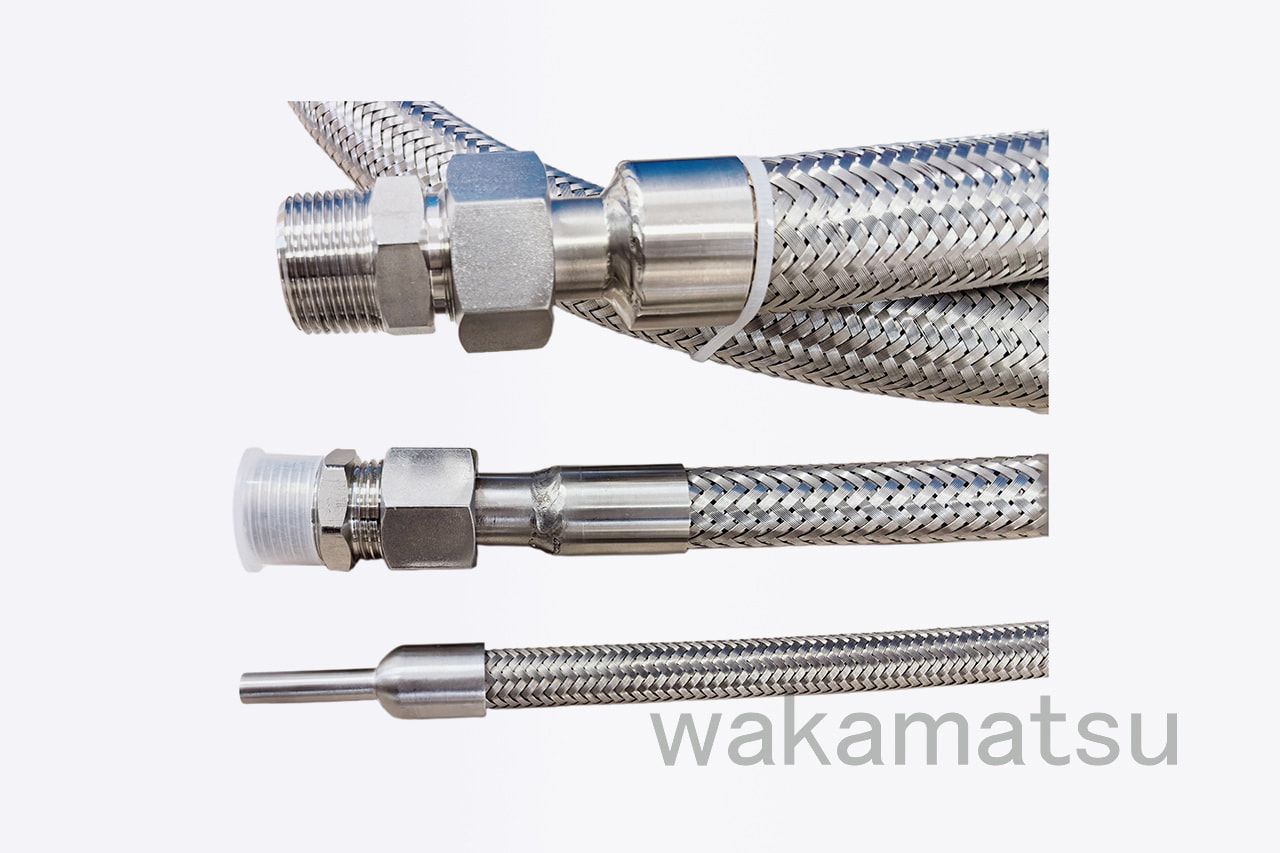 Stainless Steel Flexible Pipe Joints with Braided Mesh ReinforcementThese flanged joints feature a stainless steel bellows core and braided mesh sleeve, compensating for displacement and absorbing vibration. They mount directly between pump nozzle and pipe flange, enabling pump removal without cutting the line.View Product →
They bolt directly between the pump nozzle and the pipe flange without extra adapters, and they allow the pump to be removed without cutting the line.
Multi-ply bellows extend fatigue life by distributing strain across several thin layers. For a DN50 axial joint rated at 25 mm stroke, switching from single-ply to two-ply construction typically raises the EJMA-rated cycle count from about 3 000 to 10 000 at the same travel.
Working definition
A stainless steel flexible pipe joint is a pressure-retaining element that converts pipe movement into controlled elastic deformation of the metal bellows, instead of transferring the movement into flange loads and weld fatigue.
Selection Criteria: Pressure, Temperature, Media, and Movement
Five parameters decide whether a stainless steel flexible pipe joint survives its first inspection interval. Work through them in order and the correct part practically selects itself.
- Maximum working pressure. Include surge and hydrotest values. A double-braided hose rated at 210 bar keeps a large safety margin, but a bellows joint at the same pressure needs internal sleeves and carefully designed anchors.
- Service temperature. Pressure ratings derate above 200 degrees C; stabilised grades such as 321 hold creep strength better than 304 in continuous steam service.
- Media and chlorides. Brackish water and caustic service push the wetted material from 304 to 316L. Keep chloride content below 200 ppm for 304 and move to higher alloys above that limit.
- Movement envelope. State axial, lateral, and angular values in millimetres and degrees. Ordering a "standard flex" without quantifying the stroke is the leading cause of premature bellows failure.
- End connections. Flanged units mate to pumps with minimal bending stress. Threaded and weld-end connectors shorten the package, and bite-type fittings allow field assembly without hot work.
When the flexible joint must be removed for maintenance without breaking the whole line, a bite-type fitting on one end provides a re-tightenable metal-to-metal seal.
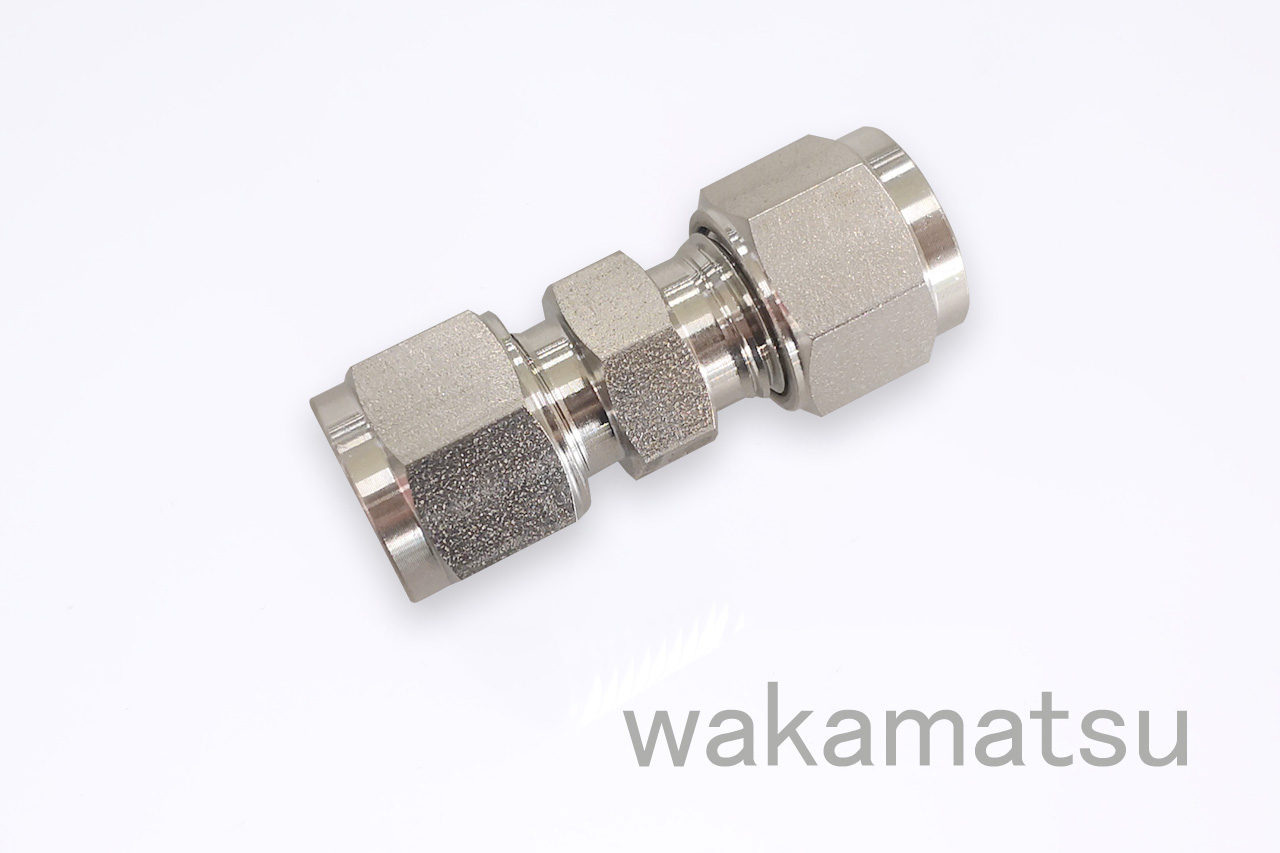 Re-Tightenable Stainless Steel Bite-Type Fitting with Dual FerruleThis straight-through fitting offers a live-load, dual-ferrule metal-to-metal seal. Its coated nut prevents seizing and permits repeated disassembly, making it suitable for maintenance scenarios where the flexible joint must be removed without breaking the entire line.View Product →
Common misstep: rating the joint by line pressure alone while ignoring pipe guide spacing. A 16 bar bellows selected for 32 mm axial stroke will fail in weeks if the guides allow the pipe to buckle sideways. The joint absorbs movement, but the pipe system must direct that movement into the bellows axis.
Installing Stainless Steel Flexible Pipe Joints by Field Rules
Most early failures of stainless steel flexible pipe joints are installation errors, not manufacturing defects. Correct installation follows five mechanical rules.
- Install the joint in its neutral position. Pre-compressing or stretching the bellows to force a fit consumes half the rated stroke before start-up.
- Anchor and guide the pipe. Put a fixed anchor on one side and slide guides at spacing that keeps the bellows centreline straight; never allow the joint to twist.
- Torque flanged bolting in a crossing pattern to one-third of bolt yield, then run a second pass to the full value.
- Protect the bellows from weld spatter and mechanical damage during tie-in welding with a removable shroud.
- Support the pipe separately. A flexible joint is a compliance element, not a hanger; pipe weight carried by the bellows guarantees premature cracking.
Weld-end flexible joints deserve extra care because porosity and lack of fusion at the bellows stub are direct causes of the weld-defect leakage failures seen in steam and chemical service.
Where the joint terminates at vibrating equipment, a short hose connector between the joint and the nozzle reduces transmitted strain at the joint flange.
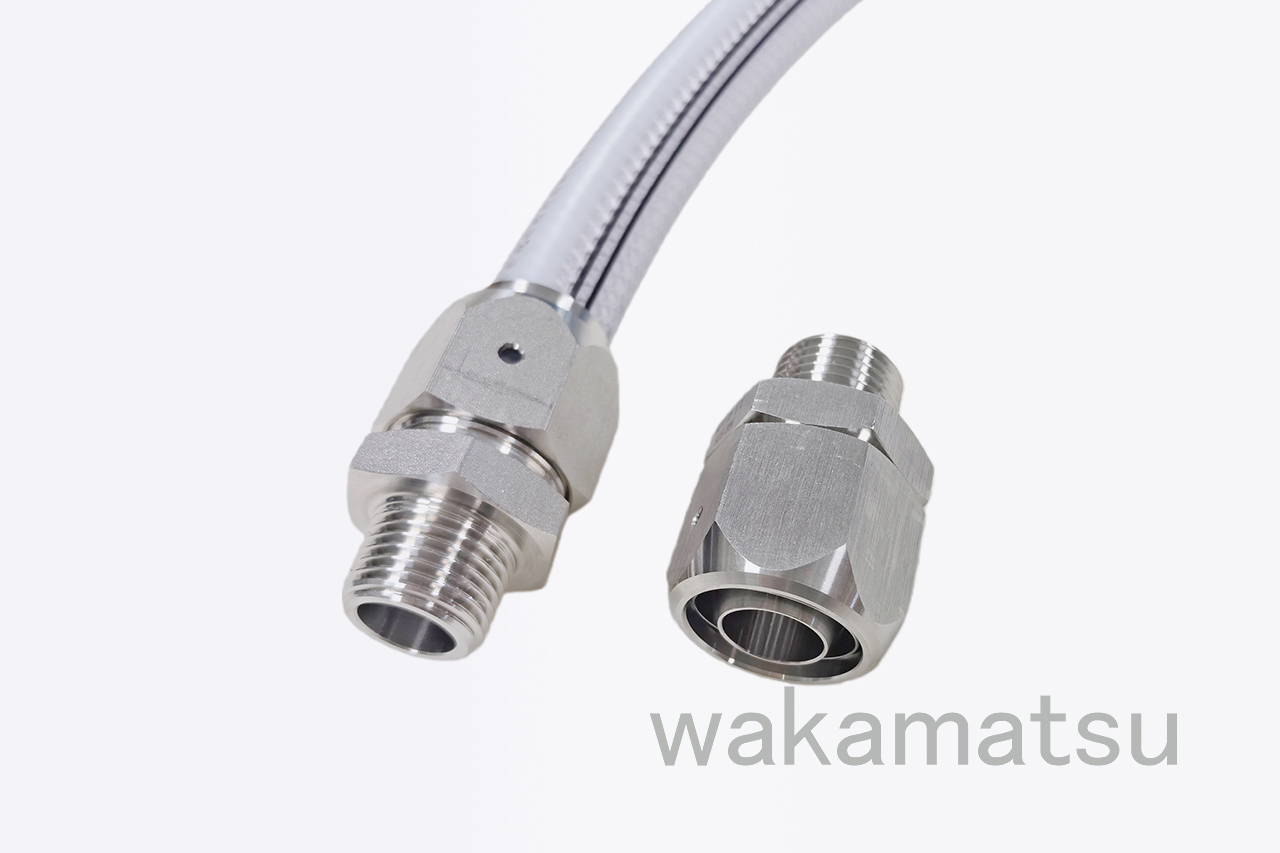 Stainless Steel Hose Connectors for Vibration-Prone EquipmentAvailable in threaded, flanged, and quick-connect styles, these high-strength stainless steel and carbon steel fittings create leak-proof connections for hydraulic and pneumatic hoses. They help reduce transmitted strain at the joint flange when terminating at vibrating equipment.View Product →
Field experience
Torsional loading is the most common installation defect found during failure analysis. Rotating the joint flange to line up bolt holes pre-stresses the bellows and cuts fatigue life by an order of magnitude.
Quality Risks When Buying Stainless Steel Flexible Pipe Joints
A stainless steel flexible pipe joint is only as stainless as its weakest component. A recurring field complaint involves braided "all stainless" hose assemblies whose end caps proved to be carbon steel or aluminized steel: the caps are strongly magnetic while 300-series stainless is not, and rust appears after the first humid or salt-laden exposure.
Three checks separate a durable part from a short-lived one. First, ask for material certificates covering the bellows, braid, and end fittings; an EN 10204 3.1 certificate traces every heat of steel. Second, run a hand-magnet test on the end caps and the outer braid. Third, inspect braid density: a quality hose carries a dense 1 x 19 or 6 x 19 weave, while coarse braid wires fret against the bellows and shorten service life.
Magnet test: hold a rare-earth magnet against the end cap and the braid. Strong attraction to the cap indicates carbon steel or ferritic stainless underneath the plating. A quality stainless steel flexible pipe joint shows little or no magnetic response on either part in the annealed condition.
Shanghai Ruosung Metal Products Co., Ltd. has manufactured stainless steel pipe joints and related connectors under ISO 9001 procedures since 2008, machining parts in its 9 400-square-metre plant and exporting to Japan, Europe, the Americas, and Southeast Asia. The company publishes its stainless steel product catalogue on its homepage so engineers can cross-reference joint, connector, and valve ratings in one place.
Frequently Asked Questions About Flexible Pipe Joint Selection
Before ordering, answer three questions: how much movement does the system produce, how hot and how corrosive is the media, and how much axial space is available for the joint. These three answers eliminate most wrong selections.
How much movement can a stainless steel flexible pipe joint handle?
Typical axial ratings range from +/-10 to +/-40 mm for single and multi-ply bellows joints from DN25 to DN150, with lateral ratings usually between +/-5 and +/-15 mm. Verify the rated cycle count at the actual stroke, because the EJMA fatigue curve trades movement against number of cycles.
Can stainless steel flexible pipe joints be used in steam service?
Yes, with three conditions: the bellows must be rated for the saturated steam temperature, the braid must allow condensate drainage, and the anchors must resist the thrust force created by steam pressure acting on the bellows effective area.
What is the difference between a flexible pipe joint and an expansion loop?
An expansion loop absorbs growth through elastic bending of a long pipe leg, which takes space and adds pressure drop. A flexible pipe joint absorbs the same movement in a compact spool, but it introduces a bellows that must be inspected and eventually replaced at the end of its fatigue life.
How often should flexible pipe joints be inspected?
Inspect at every scheduled turnaround: look for braid fretting, bellows surface cracks, discoloration from overtemperature, and evidence of torsion at the end caps. In vibration service, add an annual visual check and an ultrasonic thickness reading on the most severely stressed convolutions.
Related Products
Certificate Of Honor
If You Need More Help, Let Us Know.

ABOUT US
PRODUCTS
CAPABILITY
CONTACT US
- Phone: +86-21-59261529
- Email: sales@sh-wakamatsu.com
- Email: panhy@sh-wakamatsu.com
- Add: B3 Factory , Industrial Park, Jinze Town, Shanghai, China
Copyright © Shanghai Wakamatsu Metal Products Co., Ltd.
All Rights Reserved.Custom Stainless Steel Pipe Fitting Manufacturers, Suppliers