English
 日本語
日本語 中文
中文

Industry News
Home / News / Industry News / Stainless Steel Flange Types, Grades and Selection Guide for Piping Systems
News
 Home / News / Industry News / Stainless Steel Flange Types, Grades and Selection Guide for Piping Systems
Stainless Steel Flange Types, Grades and Selection Guide for Piping Systems
 2026.09.04
 Industry News
Content
Two quotes arrive for nominally identical DN50 (2 in.) flanges: a flat-welding slip-on in 304, and a butt-welding type in 316L quoted noticeably higher. Choosing on unit price alone is how projects end up with a flange that pits within two winters in a coastal plant, or one that will not bolt to the mating valve because the drilling standard does not match.
The conclusion first: select a stainless steel flange by answering three questions before price enters the discussion — how it attaches to the pipe, what the media and environment will do to the metal, and which standard the mating flange or valve follows. When those answers line up, a correctly installed joint holds full pressure for decades and comes apart cleanly for maintenance. When one is missed, the result is usually leakage at hydrotest, unplanned shutdowns, or rework that costs far more than the parts.
What a Stainless Steel Flange Does in a Piping System
A stainless steel flange is a machined or forged ring with a standardized bolt-hole pattern that joins pipes to pipes, valves, fittings, and vessels. The joint it forms is gasket-sealed and fully demountable, which is why flanges appear wherever a line needs inspection, cleaning, or component replacement: pump nozzles, strainers, control valves, and instrument tie-ins.
The ring does three jobs. It joins, with enough body strength that bolt load does not distort the face. It seals, because the face and gasket must hold contact stress across the whole surface — surface finish and facing type are engineering details, not cosmetic ones. And it aligns, often serving as the reference that squares up valves and equipment during installation. Stainless steel earns its place over coated carbon steel wherever moisture, chlorides, or cleaning chemicals appear, and in hygiene-driven fields such as medical equipment, where the material itself must stay corrosion-free rather than merely painted.
Five Flange Types and Where Each One Fits
Suppliers classify stainless steel flanges by how they connect to the pipe, and that choice drives both installation cost and long-term reliability. Five types cover most industrial specifications.
Butt-welding flanges for demanding lines
A butt-welding flange has a long tapered hub joined to the pipe with a full-penetration butt weld. The smooth transition from flange thickness to pipe wall spreads stress instead of concentrating it, making this the default for high pressure, high temperature, thermal cycling, and vibration. It is also the costliest standard type, requiring more machining and more skilled welding to install.
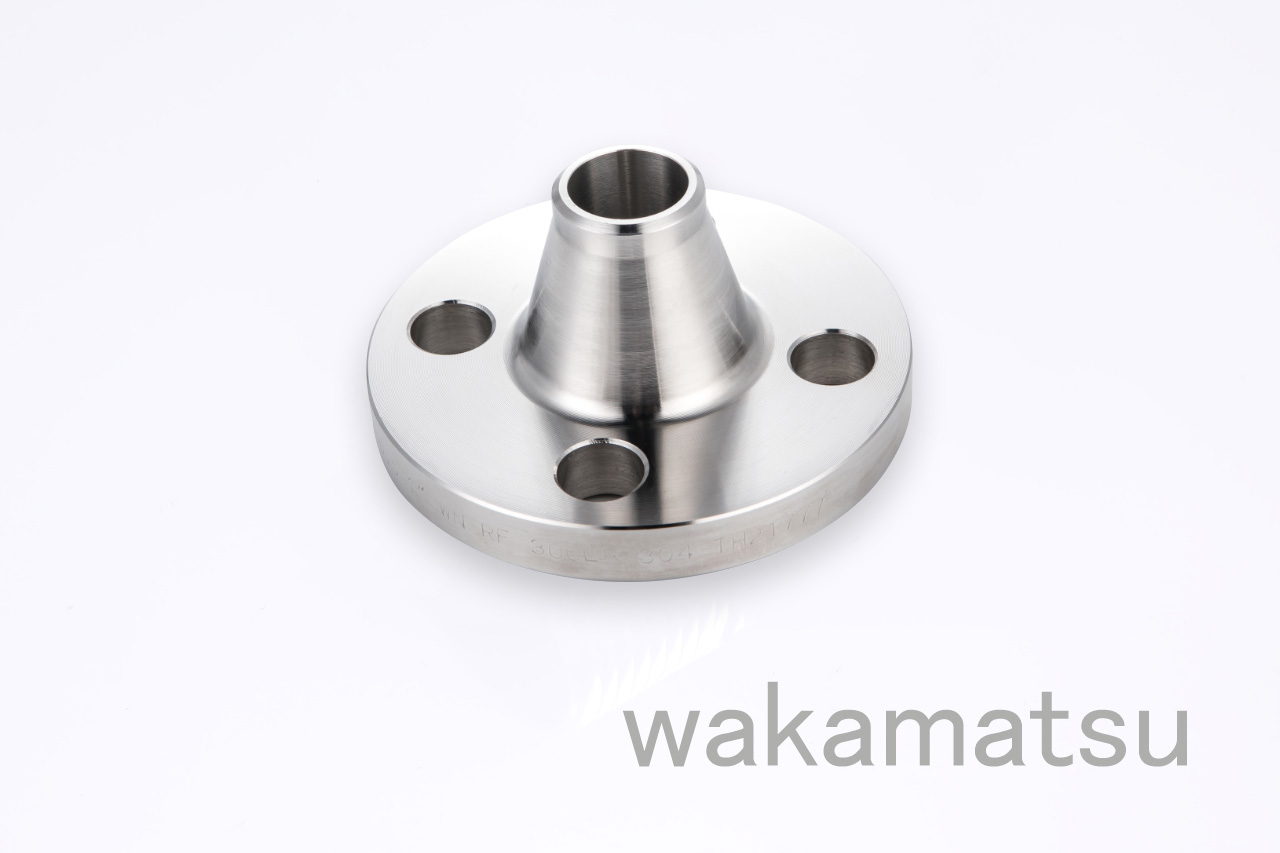 Butt Welding Flange with Neck for High Pressure PipingWith a long tapered hub joined by a full-penetration butt weld, this flange spreads stress smoothly into the pipe wall, making it the go-to choice for high pressure, high temperature, and cyclic service lines.View Product →
Flat-welding flanges for straightforward assembly
The flat-welding flange, commonly called a slip-on in ASME markets, slides over the pipe and takes two fillet welds, inside and outside. Fit-up is forgiving and installation is fast, keeping part and labor costs down. The trade-off is lower fatigue strength, so it suits utility water, compressed air, and general process lines rather than severe cyclic service.
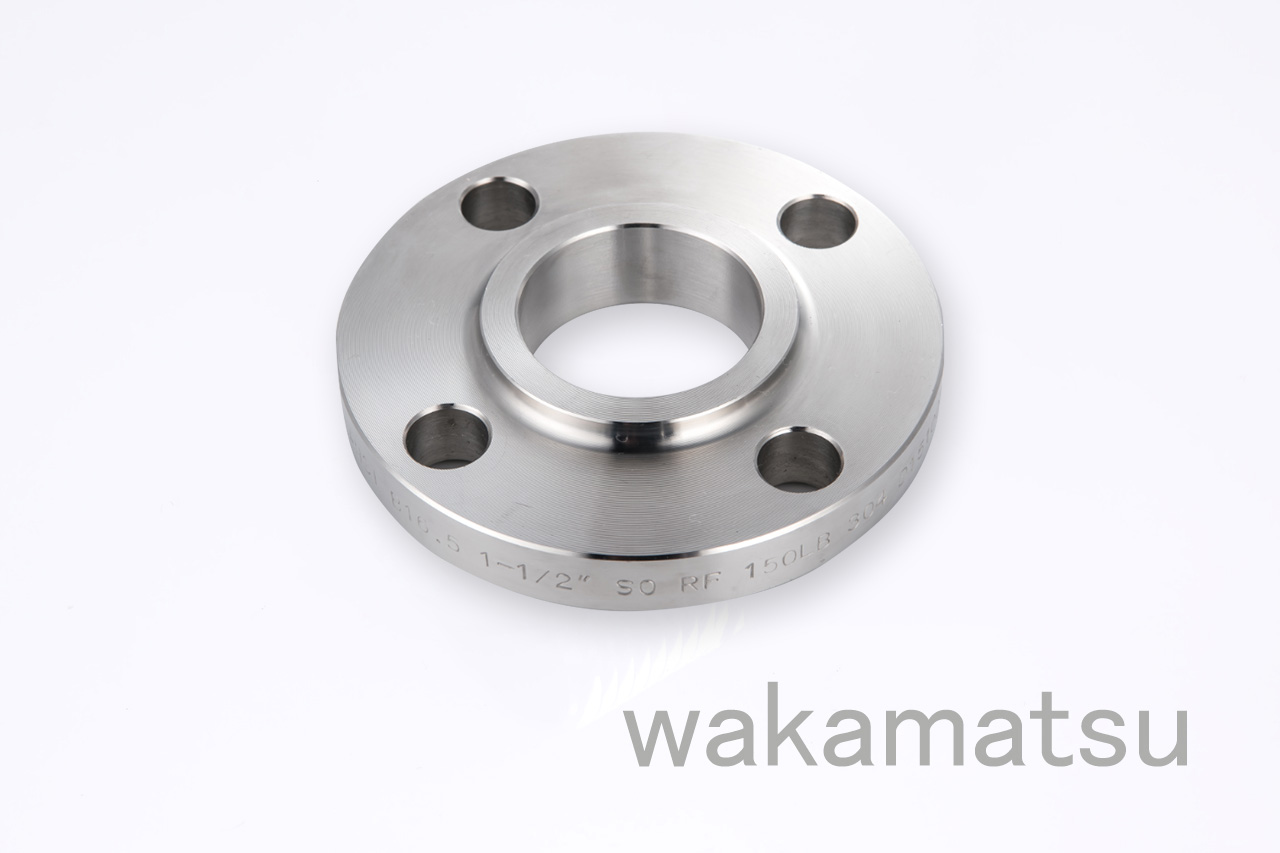 Flat Welding Flange with Neck for General Process LinesA slip-on style flange that slides over the pipe with two fillet welds, offering forgiving fit-up and fast installation at lower cost, well suited to utility water, compressed air, and general process lines.View Product →
Socket-welding flanges for small-bore connections
A socket-welding flange accepts the pipe inside a machined recess and needs one external fillet weld, normally on small bores around DN50 (2 in.) and below. The socket controls insertion depth and simplifies alignment on high-pressure small lines. One caution: the crevice between pipe and shoulder can trap fluid, so it is a poor match for media that attack stainless steel in crevices.
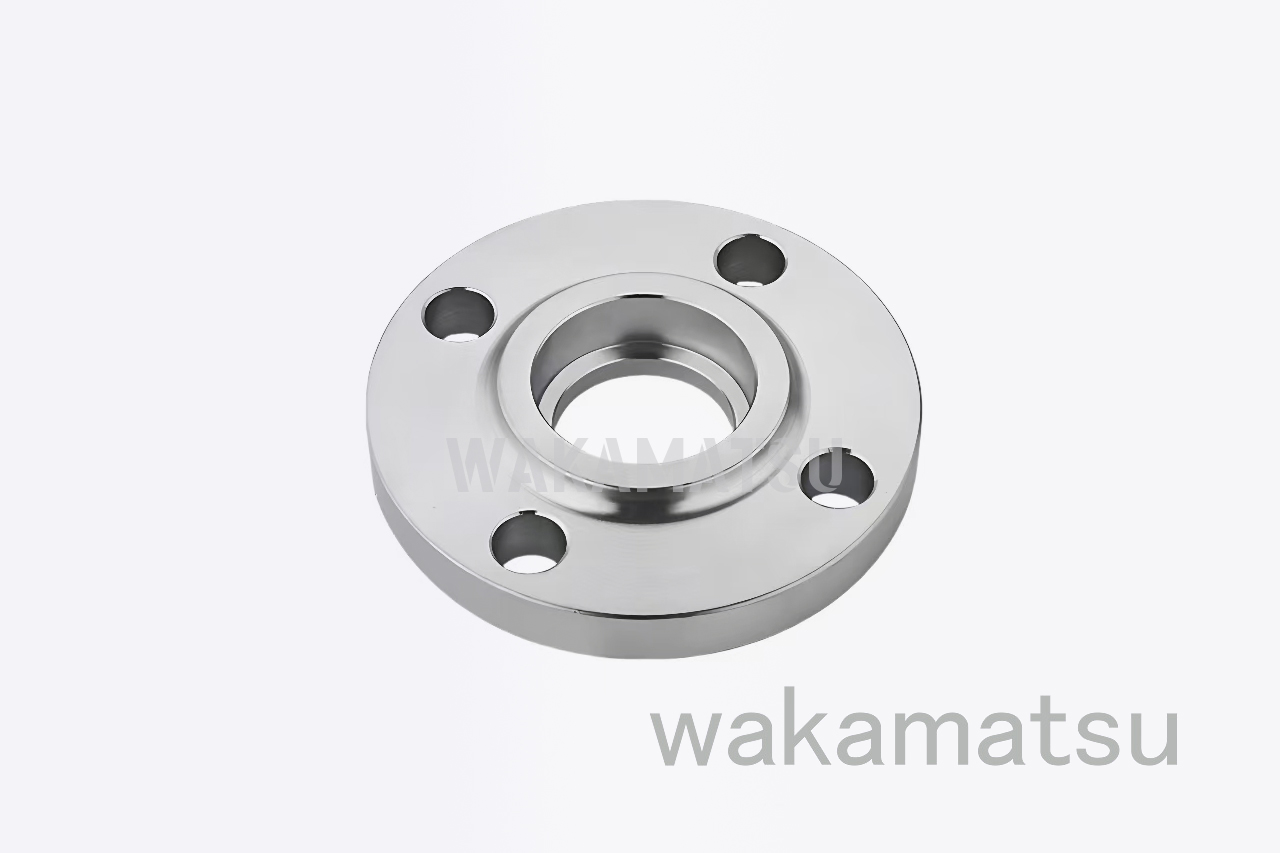 Socket Welding Flange for Small-Bore High Pressure LinesThe pipe sits in a machined socket and needs only one external fillet weld, simplifying alignment on small bores around DN50 and below, though the crevice makes it unsuitable for crevice-corrosive media.View Product →
Loose plate and blind flanges
A loose plate flange pairs a welded stub end with a backing flange that rotates freely, making bolt-hole alignment nearly effortless — useful at equipment with fixed bolt patterns and on lines dismantled often. A BL (blind) flange closes a pipe end or vessel nozzle and sees full pressure across its face, so it is thicker than other types at the same class.
| Flange type | Connection method | Best suited for | Main caution |
|---|---|---|---|
| Butt-welding (weld neck) | Full-penetration butt weld through the hub | High pressure and temperature, cyclic and vibrating lines | Higher part cost and welding skill required |
| Flat-welding (slip-on) | Pipe slides in; internal and external fillet welds | Water, air, and general utility process lines | Lower fatigue strength than a weld neck |
| Socket welding | Pipe in recess; single external fillet weld | Small bores up to about DN50 at high pressure | Crevice at the socket can trap corrosive media |
| Loose plate (lap joint) | Rotating backing flange over a stub end | Frequent dismantling; awkward bolt alignment | Backing ring material must match service conditions |
| BL (blind) | Bolted solid plate closing the line end | Line termination, vessel nozzles, future tie-ins | Sees full pressure; thickness must match the class |
Material Grades: The 304/316 Decision
Most stainless steel flanges are bought in one of two families. 304/304L, with roughly 18% chromium and 8% nickel, is the general-purpose choice for water, steam, air, and neutral products. 316/316L adds 2-3% molybdenum, which markedly improves resistance to pitting and crevice corrosion in chloride environments: coastal installations, brackish cooling water, chlorinated cleaning chemicals, and many acidic processes. A workable rule of thumb: use 304 where conditions stay dry or mildly wet, and step up to 316L as soon as chlorides or aggressive cleaning agents appear.
The L suffix matters for welded construction. Low carbon prevents carbide precipitation at the heat-affected zone, the mechanism behind intergranular corrosion in sensitized stainless steel. Since most flanges get welded, 304L or 316L should be the default unless a specification deliberately calls for an H grade for elevated-temperature strength.
The procurement risk to manage is grade substitution: mixed or mislabeled material is a common reason a "stainless" flange rusts in service. Require mill test reports tied to heat numbers for every delivery, and spot-check critical lots with a portable PMI analyzer. Documentation is what lets you defend the material to your own customer later.
Standards, Pressure Classes and Facing Types
Dimensional standards decide whether two flanges will actually bolt together. ASME B16.5 covers sizes through NPS 24 and dominates in the Americas and much of Asia; JIS B2220 with 10K and 20K ratings is standard in Japanese-market plants; EN 1092-1 with PN ratings rules in Europe. Pressure class must match on both sides of the joint. Mixing standards is a classic site problem: the bolt holes look close, but the bolt circle is a few millimeters off and the assembly will not close.
Facing is the other frequently missed detail. A raised face concentrates gasket pressure and is the default in steel systems; a flat face is chosen against brittle materials such as cast iron, where a raised face could crack the partner during bolt-up. Gasket material, bolt grade, and torque sequence complete the sealing system, so even a well-machined flange leaks with the wrong gasket.
A Buying Checklist That Prevents Leaks and Delays
Walk through this list before releasing a purchase order; each item maps to a failure mode that regularly appears at hydrotest or commissioning.
- Confirm the attachment method against your pipe schedule and outside diameter before fixing the flange type.
- Match the dimensional standard and pressure class to the mating flange or valve, checking drilling and bolt circle, not just nominal size.
- Specify the exact grade and L variant, and require mill test certificates referenced to heat numbers.
- Verify facing type and choose a gasket compatible with both the media and the operating temperature.
- Check machined dimensions such as bore clearance, hub thickness, and bolt-hole position; tolerances decide whether bolt-up goes smoothly.
- Plan welding and quality control: qualified welders, the correct fillet or butt weld profile, and post-weld pickling and passivation. Weld defects at the hub are a leading cause of joint leakage, covered in depth in our article on leakage caused by weld defects.
Where Each Combination Earns Its Keep
Different industries load these choices differently, and the same three questions resolve them all. General industrial facilities running water treatment, chemical dosing, compressed air, and steam rely heavily on flat-welding 304 flanges, reserving 316L for chloride-bearing media. Medical and high-purity equipment expects 316L with smooth, pickled surfaces, often alongside clean-flow fittings of the VCR type. Fire protection lines favor demountable joints so pumps and hydrant connections can be serviced quickly. In architectural decoration, visible flanged connections are chosen as much for finish and corrosion resistance as for strength, making grade consistency part of the aesthetic decision.
Sourcing flanges from the same manufacturer as your valves, butt-weld fittings, and connectors simplifies matching, because every component can be specified against one standard and pressure class from the start. Shanghai Wakamatsu Metal Products has machined stainless steel flanges and piping components in Shanghai since 2003, works on CNC equipment under an ISO 9001 certified quality system, and supplies buyers across Japan, Europe, the Americas, and Southeast Asia. The full component range can be reviewed on the company's complete stainless steel product site — and when type, grade, and standard all line up before ordering, the joint rarely shows up on the punch list.
Related Products
Certificate Of Honor
If You Need More Help, Let Us Know.

ABOUT US
PRODUCTS
CAPABILITY
CONTACT US
- Phone: +86-21-59261529
- Email: sales@sh-wakamatsu.com
- Email: panhy@sh-wakamatsu.com
- Add: B3 Factory , Industrial Park, Jinze Town, Shanghai, China
Copyright © Shanghai Wakamatsu Metal Products Co., Ltd.
All Rights Reserved.Custom Stainless Steel Pipe Fitting Manufacturers, Suppliers