English
 日本語
日本語 中文
中文

Industry News
Home / News / Industry News / Stainless Steel Forged Flanges: Types, Standards, Pressure Classes, and Buying Guide
News
 Home / News / Industry News / Stainless Steel Forged Flanges: Types, Standards, Pressure Classes, and Buying Guide
Stainless Steel Forged Flanges: Types, Standards, Pressure Classes, and Buying Guide
 2026.08.21
 Industry News
Content
A piping engineer sourcing flanges for a new stainless steel line often receives quotes that look similar at first glance: same nominal size, same pressure class, similar material notation. But the difference between a flange that seals reliably for twenty years and one that leaks after a few thermal cycles is rarely visible on the surface. Forged stainless steel flanges carry that difference in their grain structure, material traceability, and the discipline of the shop that machines them.
If you focus on material grade, facing, pressure class, and the manufacturer's inspection habits, specifying stainless steel forged flanges becomes straightforward. Here is what matters, and what to verify before you approve a supplier.
What Defines a Stainless Steel Forged Flange?
Forging is not simply hot-forming a metal blank. In a properly forged flange, the billet is heated to a controlled range and then squeezed by mechanical or hydraulic pressure so that the grain flow follows the flange hub and rim. This orientation gives the flange better toughness in the radial direction than a flange cut from plate or cast into shape. That is why pressure piping standards and engineering specifications often require forged flanges for high-pressure or cyclic-service applications.
Most stainless steel forged flanges are made from austenitic grades such as 304/304L and 316/316L, or from duplex grades such as 2205 and 2507. The chemical composition governs corrosion resistance; the forging and heat treatment govern mechanical properties. In the ASTM A182 specification, common forged stainless grades are designated F304, F304L, F316, F316L, F321, F51, and F44. These designations appear on material certificates and should match the stamped marking on each flange.
Types of Forged Flanges and Where Each One Fits
For a given nominal size and pressure class, the flange type determines how the flange attaches to the pipe and how stresses are transferred. The table below summarizes the most common forged flange types in stainless steel piping systems.
| Flange Type | Attachment | Typical Use |
|---|---|---|
| Weld Neck | Butt-welded to the pipe with a tapered hub | High-pressure lines, cyclic loads, severe service |
| Slip-On | Slides over the pipe and fillet-welded on both sides | Lower-pressure systems, moderate temperatures, cost-sensitive installations |
| Socket Weld | Pipe inserted into a socket and fillet-welded | Small bore, high-pressure piping where space is tight |
| Lap Joint | Used with a stub end and backing flange | Systems requiring easy alignment or frequent dismantling |
| Blind | No center bore; bolted to another flange | Dead ends, isolation points, test connections |
| Threaded | Screwed onto the pipe without welding | Non-critical, low-pressure and small-diameter lines |
Weld Neck Flanges
Weld neck flanges are the first choice for high-integrity stainless steel piping. The tapered hub transitions stress into the pipe wall, and the full-penetration butt weld creates a smooth bore that resists turbulence and fatigue. For processes with high pressure or severe bending loads, our stainless steel butt-welding flanges are machined with consistent weld bevels and checked face flatness to simplify fit-up in the field.
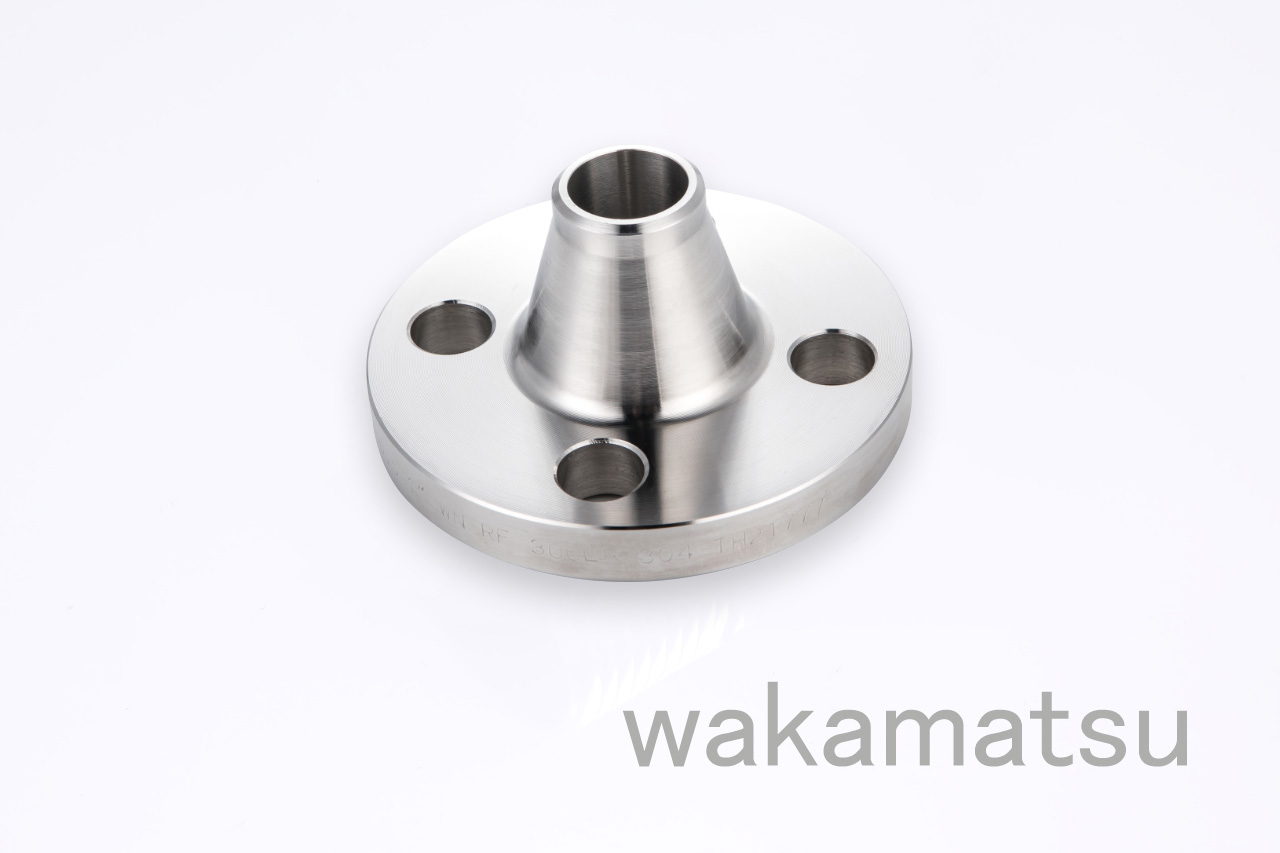 Custom OEM/ODM Butt Welding Flange with Neck Manufacturers, FactoryShanghai Wakamatsu Metal Products Co., Ltd. is China Custom OEM/ODM Butt Welding Flange with Neck Manufacturers and Factory,View Product →
Socket Weld and Slip-On Flanges
Socket weld flanges are common in smaller bore, high-pressure lines where a single fillet weld is enough. They are easier to align than weld neck flanges but should not be used in highly corrosive or cyclic service because the internal socket gap can create a crevice. Our stainless steel socket-welding flanges are made with controlled bore depth and clean internal surfaces for reliable small-bore joints.
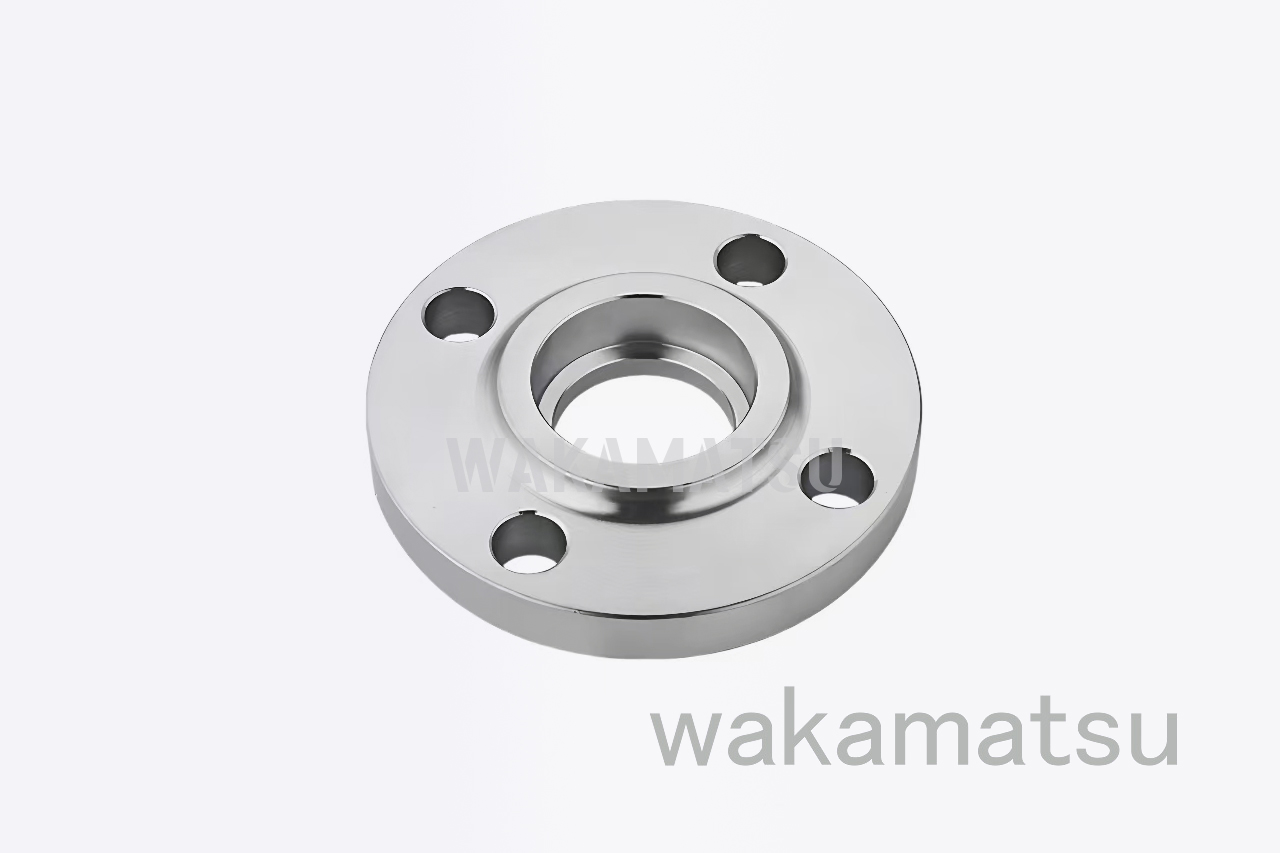 Custom OEM/ODM Socket Welding Flange Manufacturers, FactoryShanghai Wakamatsu Metal Products Co., Ltd. is China Custom OEM/ODM Socket Welding Flange Manufacturers and Factory,View Product →
Slip-on flanges are less expensive and simpler to position, but they produce a lower fatigue strength because the pipe bore continues through the flange without a smooth transition. For moderate pressures and temperatures, stainless steel flat-welding flanges offer a practical balance between cost and performance.
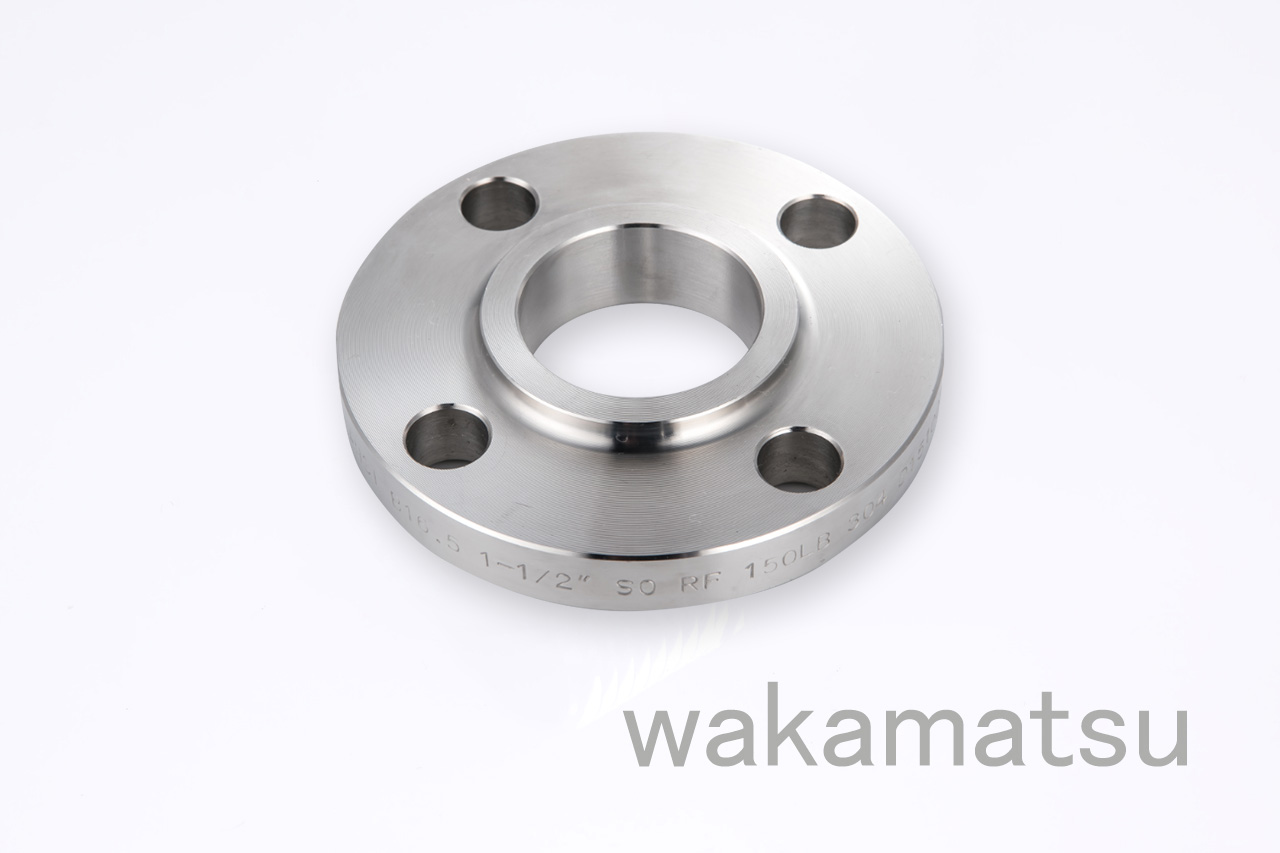 Custom OEM/ODM Flat Welding Flange with Neck Manufacturers, FactoryShanghai Wakamatsu Metal Products Co., Ltd. is China Custom OEM/ODM Flat Welding Flange with Neck Manufacturers and Factory,View Product →
Standards, Pressure Classes, and Facing
For stainless steel forged flanges, the governing standard in most projects is ASME B16.5, which covers flanges from 1/2 inch through 24 inches. It defines dimensions, tolerances, facing, and pressure-temperature ratings. For larger sizes, ASME B16.47 applies.
Pressure class determines how much pressure a flange can hold at a given temperature. Class 150 is common for low-pressure water service, Class 300 for moderate process lines, and Class 600 or higher for severe services. Facing type matters as well: raised face flanges are standard for most applications, flat face flanges are used when mating to cast iron or flat-body equipment, and ring-type joint flanges are used for high-pressure gas and critical services.
The roughness of the raised face is usually specified as 125 to 250 microinches. This surface texture gives the gasket material enough grip without requiring excessive bolt torque. Always confirm the facing finish on the drawing, because an over-polished face changes gasket selection.
How to Qualify a Manufacturer of Stainless Steel Forged Flanges
Material grade is only half the story. A flange with the right chemistry can still fail if the forging process reduces ductility or the machining leaves tool marks. Here are the checks that matter before approving a supplier:
- Verify the material test certificate. The certificate must identify the heat number, chemical analysis, mechanical properties, and the governing ASTM A182 grade.
- Confirm pressure-temperature rating and face dimensions against ASME B16.5 using actual measurements, not only the label.
- Check the surface finish and visible defects. Forged flanges should be free of cracks, folds, and scale pits.
- Ask how the supplier controls forging temperature and heat treatment. Duplex stainless steel, for example, requires controlled solution annealing and rapid cooling to restore the correct ferrite-austenite balance.
- Review machining tolerance and quality records. Our plant uses CNC equipment for flange facing and drilling and has maintained ISO9001 certification since 2008.
Shanghai Wakamatsu Metal Products has manufactured stainless steel flanges and related pipe components for more than 20 years. The company's Japanese-invested management and engineering team bring a strict attitude to quality, which shows in inspection outputs and stable product consistency. If you are sourcing flanges for a project that demands traceability, this manufacturer has the documentation and process discipline to meet it.
Common Specification Mistakes to Avoid
Most flange failures on paper happen long before the flange reaches the site. These specification errors are worth reviewing with your engineer:
- Choosing the wrong stainless steel grade. 304/304L is not equivalent to 316/316L in chloride environments; high chloride or low pH service often demands 316L or a duplex grade.
- Ignoring the pipe schedule. A weld neck flange must match the pipe inside diameter; ordering a standard bore for schedule 10 pipe creates misalignment and weld prep problems.
- Mixing facing types. A flat face flange bolted to a raised face flange can concentrate stress and crush the gasket.
- Not checking bolt circle and hub length. Small dimensional errors on bolting are a common cause of site delays.
- Taking the word "forged" at face value. Confirm the manufacturing process because some flanges sold as forged are actually plate products with a flange profile.
No flange works well if the specification is wrong, and no specification means much if the supplier does not have the habits to execute it. Exact pipe dimensions, corrosion conditions, design pressure, and temperature all funnel into the flange decision. If you need practical help applying these parameters to your own line, the team at Shanghai Wakamatsu can start from the pipe design and recommend a forged flange type that balances safety and cost. For matching fittings, our guide to stainless steel butt-weld fittings covers the companion components you will likely need in the same line.
Certificate Of Honor
If You Need More Help, Let Us Know.

ABOUT US
PRODUCTS
CAPABILITY
CONTACT US
- Phone: +86-21-59261529
- Email: sales@sh-wakamatsu.com
- Email: panhy@sh-wakamatsu.com
- Add: B3 Factory , Industrial Park, Jinze Town, Shanghai, China
Copyright © Shanghai Wakamatsu Metal Products Co., Ltd.
All Rights Reserved.Custom Stainless Steel Pipe Fitting Manufacturers, Suppliers