English
 日本語
 中文


Industry News
Home / News / Industry News / 316 Stainless Steel Tube Fittings: Material Guide and Connection Selection
News
 Home / News / Industry News / 316 Stainless Steel Tube Fittings: Material Guide and Connection Selection
316 Stainless Steel Tube Fittings: Material Guide and Connection Selection
 2026.10.28
 Industry News
Content
- 1 Why 316 Stainless Steel Tube Fittings Beat 304 in Chloride Service
- 2 316 Stainless Steel Tube Fittings: Choose 316 or 316L by Welding Exposure
- 3 Bite-Type, Threaded, or Quick-Connect: Connection Choices for 316 Fittings
- 4 Pressure, Temperature, and Media: Three Numbers That Define a 316 Fitting
- 5 Supplier Verification Checklist for 316 Tube Fittings
- 6 FAQs on 316 Stainless Steel Tube Fittings
When a 304 compression fitting fails on a chloride-dosed cooling line, the first sign is usually a rust-colored streak below the ferrule. In one plant review, 316 stainless steel tube fittings replaced the 304 units after 14 months of service and then ran for three more years without a single wetted-joint leak.
That outcome depends on more than writing "316" on a purchase order. 316 stainless steel tube fittings are machined from bar or forging stock that carries 16-18 percent chromium, 10-14 percent nickel, and 2-3 percent molybdenum, and the molybdenum is what changes pitting behavior. But grade alone does not decide service life: connection geometry, welded or unwelded condition, and the supplier's material traceability all determine whether the fitting survives.
Shanghai Ruosung Metal Products Co., Ltd., a Japanese-invested manufacturer operating near Shanghai since 2003, produces 316 stainless steel tube fittings for instrumentation, hydraulic, and process-piping applications, with shipments to Japan, Europe, Southeast Asia, and the Americas. Its engineers start every selection with three questions: what is in the media, how hot does the joint get, and how often will an operator open the fitting.
Why 316 Stainless Steel Tube Fittings Beat 304 in Chloride Service
The single reason to move from 304 to 316 is molybdenum: at 2.0 to 3.0 percent, it raises the pitting resistance equivalent number (PREN) from about 19 in 304 to about 26 in 316. That is a direct measure of how much chloride the passive layer can tolerate before pits initiate.
A 316 fitting on a chemical injection skid resists chloride pitting and crevice corrosion far better than a 304 fitting of identical geometry. The mechanism is passive-film stability: molybdenum helps the chromium oxide film re-form quickly after local damage, so small defects stay repairable instead of growing into pits.
PREN, or pitting resistance equivalent number, is a calculated ranking of a stainless steel's resistance to pitting corrosion, computed as PREN = Cr + 3.3Mo + 16N. A higher PREN means a higher chloride concentration is required before a pit can form and propagate.
Fittings follow different material specifications than tube. A fitting body is normally machined from ASTM A276 bar or ASTM A182 forging stock on a CNC lathe, and the nut and ferrule may come from separate heats. For the assembly as a whole to deliver the expected PREN, every component must be 316-family material, not just the visible body.
The corrosion resistance of a 316 stainless steel tube fitting is only as strong as its weakest component. Specify 316-grade ferrules and nuts, not just a 316 body, and request heat-level material certificates on each part.
316 Stainless Steel Tube Fittings: Choose 316 or 316L by Welding Exposure
Choose 316L when the fitting or its tube will be welded in service, and straight 316 when the joint is purely mechanical; both grades have the same pitting resistance, but the carbon limit is not the same.
Straight 316 allows up to 0.08 percent carbon. When the part is welded, the heat-affected zone passes through the 425-815 degrees Celsius range, where carbon combines with chromium at the grain boundaries. The chromium-depleted zone that results is vulnerable to intergranular attack. This process, called sensitization, is effectively prevented by the 0.03 percent carbon ceiling in 316L.
16-18%Chromium
2-3%Molybdenum
0.03%Carbon max in 316L
~26PREN of 316 / 316L
| Alloy | Carbon max | Molybdenum | PREN | Preferred use |
| 304 | 0.08% | None | ~19 | Indoor or mildly aggressive service |
| 316 | 0.08% | 2.0-3.0% | ~26 | Chloride service, mechanical joints |
| 316L | 0.03% | 2.0-3.0% | ~26 | Welded assemblies, thick sections |
In a bite-type fitting, welding rarely touches the sealing area, so 316L is an added safety margin for field-welded instrument tubing or threaded-to-weld adapters. In a hygienic or pharmaceutical skid that is welded and then passivated, 316L is the normal specification.
Bite-Type, Threaded, or Quick-Connect: Connection Choices for 316 Fittings
Alloy selection is wasted if the sealing geometry cannot hold the tube under operating vibration, because a 316 stainless steel tube fitting fails most often at the seal interface, not in the wall.
Bite-Type Fittings for High-Pressure and Instrument Service
Bite-type fittings, also called single- or double-ferrule compression fittings, press a heat-treated ferrule into the tube surface when the nut is torqued. The radial bite locks the tube and forms a metal-to-metal seal. On 316 tubing the work-hardening rate is steep, so ferrule hardness control is critical; a good bite leaves a clean, uniform ridge around the tube.
 W-KTC Stainless Steel Tube Plug with Dual-Ferrule DesignThis tube plug uses a live-load dual-ferrule design to seal tube ends reliably. Its coated nut prevents seizing and supports repeated assembly, making it a practical choice where bite-type joints are specified.View Product →
Threaded Connectors for Manifolds and Disassembly
Threaded connectors use taper threads such as NPT or BSPT, or parallel threads with a sealing washer or O-ring. They suit instrument roots, manifolds, and joints opened monthly, but the thread flank becomes the pressure boundary, so the allowable working pressure is usually lower than a bite-type fitting of the same size. For a closer look at thread form and sealant selection, see our guide to choosing corrosion-resistant stainless steel threaded connectors.
Quick Connectors for Frequent Make-and-Break
Quick connectors are for lines that are disconnected daily: calibration rigs, nitrogen purge points, and test equipment. The body is 316, and the seal is typically a fluororubber or PTFE element that must be compatible with the medium. They are not a substitute for a permanent bite-type joint on a high-pressure line.
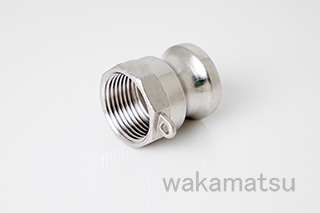 W-KSA Stainless Steel Quick Connector for Frequent DisconnectionDesigned for lines disconnected daily, this 316 stainless quick connector suits calibration rigs and purge points. Confirm seal compatibility with your media, as it is not intended for permanent high-pressure joints.View Product →
Threaded at a glance
- Seals at thread flanks; needs sealant or washer
- Reusable with tools; simple field assembly
- Better for low-pressure lines and frequent access
Bite-type at a glance
- Seals at ferrule contact; metal-to-metal
- Vibration-resistant; higher pressure rating
- Ferrule should be replaced after disassembly
Pressure, Temperature, and Media: Three Numbers That Define a 316 Fitting
A 316 stainless steel tube fitting must be rated for the worst combination of pressure and temperature in the cycle, not the nominal shop-floor rating, because allowable stress drops as temperature climbs.
Media comes first: chlorides above roughly 200 ppm accelerate pitting on 304 and start to matter on 316; reducing acids and sulfurous streams require checking whether 316 is the right alloy at all. Temperature comes second: 316 resists oxidation to about 870 degrees Celsius in air, but mechanical joint ratings follow pressure-temperature derating curves, so a joint rated at 350 bar at 38 degrees Celsius will not hold that rating at 200 degrees Celsius. Vibration comes third: bite-type joints tolerate both vibration and thermal cycling well, while threaded joints can loosen unless locked with thread adhesive or a locking wire.
 Stainless Steel Bulkhead Fittings TT Series with Female or Male ThreadsOffered in SUS304 machined or SCS13 cast versions, these bulkhead fittings handle normal pressure up to 2.5 MPa and a maximum of 3.5 MPa. They suit panel or wall mounting when media, temperature, and vibration are considered.View Product →
Work through these six points before sending a request for quotation:
- Record the fluid name and chloride concentration.
- Note the maximum temperature the joint sees, not the average.
- Derive the pressure at that temperature.
- Estimate how many times the fitting will be opened per year.
- Select the connection family from the service conditions.
- Confirm the sealing element material for quick connectors or the sealant for threaded types.
Process engineers use a practical rule of thumb: if the line carries chlorinated water above 60 degrees Celsius, specify 316L for welded joints and keep the chloride concentration below 1000 ppm at the wetted surface where pitting was previously observed.
Supplier Verification Checklist for 316 Tube Fittings
Accept only fittings supported by material certificates, batch markings, and a supplier who can explain how the body, nut, and ferrule are controlled as separate material inputs; an unverified "316" stamp has no value in an audit.
- EN 10204 3.1 or equivalent ASTM material test certificates covering the chemical composition of each heat.
- Dimensional verification: thread gauge checks, ferrule seat depth, and concentricity for bite-type fittings.
- Surface finish and passivation records for hygienic and pharmaceutical lines.
- Batch traceability codes marked on cartons and on each fitting.
- Export packaging that protects threads and ferrules during sea or air freight.
Shanghai Ruosung Metal Products Co., Ltd. has held ISO 9001 certification since 2008 and documents each 316 heat from incoming bar stock through CNC machining to final thread inspection, a level of control that export buyers in Japan and Europe expect.
FAQs on 316 Stainless Steel Tube Fittings
Can 316 tube fittings be welded directly onto 316 tubing?
Yes, but specify 316L for both the tube and the fitting when the joint is welded, use an inert gas purge inside the tube during welding, and passivate the weld area afterward to restore the oxide layer.
Are 316 and 316L interchangeable in a threaded fitting?
For a purely threaded and unwelded joint, the service performance of 316 and 316L is nearly identical. The material certificate must still match the purchase order, because an auditor will not accept substitution.
What is the maximum working pressure of a 316 stainless steel tube fitting?
Small bite-type fittings on seamless 316 tube are commonly rated from 300 to 600 bar at room temperature. Threaded NPT fittings usually carry lower ratings. Confirm the manufacturer's pressure-temperature chart for the exact size and connection type.
How can I verify that a fitting is genuinely 316?
Use positive material identification (PMI) with an XRF analyzer, request the EN 10204 3.1 certificate, and check for the machine-stamped heat code. A magnet test is not reliable, because austenitic 316 is largely non-magnetic in the annealed condition.
Certificate Of Honor
If You Need More Help, Let Us Know.

ABOUT US
PRODUCTS
CAPABILITY
CONTACT US
- Phone: +86-21-59261529
- Email: sales@sh-wakamatsu.com
- Email: panhy@sh-wakamatsu.com
- Add: B3 Factory , Industrial Park, Jinze Town, Shanghai, China
Copyright © Shanghai Wakamatsu Metal Products Co., Ltd.
All Rights Reserved.Custom Stainless Steel Pipe Fitting Manufacturers, Suppliers